Showing posts with label cycling in Ottawa. Show all posts

Friday, July 30, 2010

Gov't Downsizing


These mini-traffic lights were on a post in Gatineau. I could not determine if they were for cyclists. Or pedestrians. Or if they went off and on with the bigger lights.

I recall seeing these everywhere in France, but that is because they skip the big light fixtures on the far side of the intersection in favour of big ones over the stop line only.

The plethora of push buttons didn't make it any clearer. I eventually walked my bike across against a red light (I was on a bike path detour that led me to the intersection and abandonned me).

It felt like bait and switch. Segregated bike path: good. Detour sign -- they were thinking of me! good. Abandonned at the intersection: bad.

Ottawa has more overhead traffic signals than anywhere I have been in the world (and that's lots of places!). More signalized intersections. More signals at the intersection. More posts. More big metal arms. More signage. No wonder we are high tax and low results sort of place, the highest and best use of tax dollars is installing signalized intersections. Maybe, just maybe, the new age of austerity will give us these cuter, more friendly and human scaled signals.

Monday, July 26, 2010

Sidewalk to No-where

the sidewalk on the west side of Sliddel approaching the Ottawa River Commuter Expressway


The sidewalk on the east side of Sliddel

Sliddel is a little street that connects the new trafic roundabout at Bayview-Burnside to the Ottawa River Commuter Expressway. As shown, it has sidewalk stubs that sort of die as they approach the NCC lands.

The City and NCC had no apparent problems with deciding where to put cars, curbs, traffic signals, and sod. They have lots more problems with pedestrians and cyclists.

Why dont the sidewalks go right out the traffic lights where people cross? According to city staff:
At the time of our project design, they indicated to us that they would not support a pedestrian crossing across the Ottawa River Parkway at Slidell Street.


That being said, we have just worked out some details with the NCC to improve the accessibility at this intersection, in advance of the completion of their overall plans for the area in conjunction with future developments. Painted cross-walks, pedestrian push buttons and depressed curbs should be installed at the intersection within the next few weeks.

Things are not quite so optimistic for cyclists. The roundabout lacks cycling guidelines, preferably instructing cyclists to take the centre of the lane. The City is consulting with the traffic and cycling dept to see if anything is warranted.

Thursday, July 22, 2010

Metering thoughts


The City continues -- with some delays* -- to replace parking meters with pay-and-display kiosks.

The old meters are not immediately removed, however, since motorists are used to what they look like and seek them out. Instead, each one is converted for six months or so to signs telling motorists to look for the pay-and-display kiosk.

After that breaking in period, the old meters are removed. All of them. A small percentage of them -- 12% --  will be retrofited to become bike hitching posts. The city will then go out to find places to locate these new posts.

Some meter posts perhaps should be removed. The ones immediately adjacent a curb, for example, which would sometimes get in the way of car doors [more car first thinking here...].  But the city being run on a rational and systems based approach, instead of removing just the problem posts removes ALL of them, and will send out crews to reinstall them in new locations. Criteria had to be developed for where they will be put. Not along the curb. Not along buildings or fences (as in the picture above) because then cycles cannot be put on both sides of the post.

Wouldn't it have been cheaper to identify which posts need to be removed, and left in place the ones that could be converted to cycle posts? Under the city's plan, we go to the expense of removing all the posts, developing a new location plan with all sorts of location criteria, and then reinstalling the posts, which is so expensive it will take years to get just some of them reinstalled. I'm willing to bet that while parking meter posts could be squeezed in anywhere they city wanted, the new cycling post criteria will be so tough we will shortly be told we can't have a post here or there because they dont fit the criteria.

Local businesses are annoyed at the lack of bike parking posts now. With the removal of the meters, there will be even fewer hitching posts. I already see cycles locked to benches and trees along Preston. Both the Somerset/Chinatown BIA and the Preston BIA have asked the city to do a one for one replacment of parking meter posts for cycle hitching posts, and the response was negative.

Next summer, when all the old parking meter posts are gone, and the few recycled cycle posts are in ... the shortage will become apparent. Four thousand parking meter posts will be missing, only 500 new posts may have been installed. Media can pencil it in for next June: write story on shortage of bike parking spots.


*delays ... the new pay-and-display kiosks are made in France. There have been delays getting them to Ottawa by shipping container as this is a peak-season for trans-atlantic shipping, and now the port of Montreal is closed due to a labour dispute.

Wednesday, July 14, 2010

Economical thirst quenching


My bike panniers will each hold a six pack very nicely. It's a bit too precarious to fit in a 12 pack.

If you go to the LCBO, two six packs will cost you the six pack price times two.

If you go the Beer Store, their policy is two six packs will cost you a twelve pack (and two twelve packs costs same as a 24).

I think the Somerset Beer store is a fabulous place. Except ... expect some long lines if you show up at 10am Monday (recycling day).

Tuesday, July 13, 2010

Lemieux Island area (iv)


At the south (Ottawa) end of the Prince of Wales railway bridge over the Ottawa River, the City has installed large gates & fences to keep peds and cyclists from using the bridge as a shortcut to Gatineau.

Thwarted peds have kicked down the fence, whose posts were bolted into concrete, etc etc.

There is a security guard on the Gatineau side, 24/7. If someone crosses the bridge, he points out the fence is there to keep people off because it is dangerous to use the bridge. So he sends the ped or cyclist back to the Ottawa side. There is a certain logic in this.

Would it be too logical to notice the obvious: there is a strong desire by peds and cyclists to use this bridge to join Ottawa and Gatineau. *  Rather than a fence, how about installing a deck and repairing the cable railing, and actually let people use the bridge. Imagine, an interprovincial bridge without cars! Naw, couldn't be done.


*Even Mr Greber called for it to link the Airport Parkway via a road through Carleton to the Champagne Parkway to the bridge to Fairy Lake Parkway to the Gatineau. We hopefully will never get such a road ... but a cycle path would be useful.

Sunday, July 11, 2010

Lemieux Island area (iii)

Lemieux Island has a pleasant park on west and south sides of the Island. Most of the Island is fenced off to guard the water filtration buildings.

This vehicle-proof gate and lengthy stone barricade prevents vehicles from accessing a service road around the south side of the Island. The narrow road/path beyond has nice pedestrian-scale lighting and is a popular dog running / dog swimming / occasional-human swimming area.

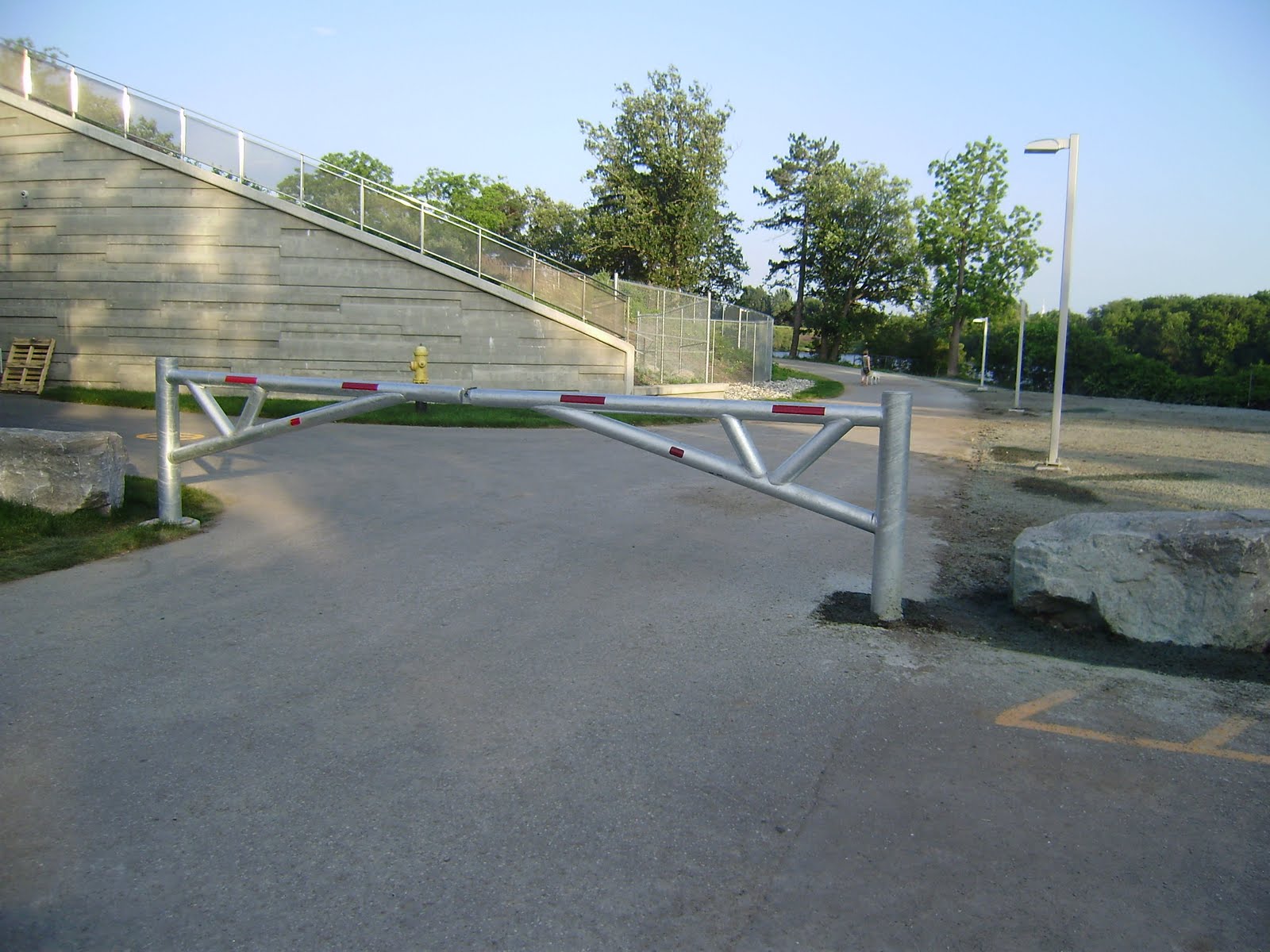
The barrier to prevent unauthorized vehicle access, which is fine. But why does have have to block 100% of the paved surface, forcing peds to walk on the freshly seeded sides? Doesn't anyone plan for pedestrians or cyclists??


While not terribly attractive, this barrier on Echo Drive is much more pedestrian and cyclist friendly. Just cycle or walk on through. Easy peasy. No curbs to jump, nor fences to climb. This type of barricade is compliant with the ideals of bicycle boulevards (long stretches of street that thwart through-cars but encourage cycling).

Monday, June 28, 2010

383 Albert, transit oriented parking requirements


The pictures above show the Claridge proposal for three residential (condo) towers in downtown Ottawa. As noted in a post a few days ago, they are to be built on the lot between the Crowne Plaza Hotel and 151 Bay condos. The current parking lot location abuts Barabarella's dancing establishment, which will remain after this project is built.

The two 28 storey and one 22 storey towers will have approx 481 apartments. They are located directly above the proposed west downtown LRT station which is under Albert Street. Perhaps those delighted looking ladies in the photomontage just exited the LRT and are headed towards Minto Place ...

The city rationalizes a big part of its LRT expenditure on intensified infill development around the stations. As part of this intense Transit-Oriented-Development (TOD) the plans call for high density and reduced parking.

Claridge is proposing to provide 365 residential parking spaces (365spaces/481units=75% parking). This is less than what developers usually provide for condos, for eg along Richmond Road, West Wellie, or Champagne Avenue they provide 113% (1.13spaces per unit). Better developers provide reserved prime spots for VirtuCar since each VirtuCar satisfies approximately 17 households, ie eliminates 17 parking stalls which cost developers approx $30k each to build (several developers I talked to said the 30k cost/price is cost recovery).  Claridge is also providing 241 bike parking spaces (50%) which I suspect is way too low.

So what does the City of Ottawa require as the MAXIMUM number of spaces the developer can provide for this Transit Oriented Development, so as to encourage people to walk and use transit?? Why ... the maximum number of spaces within 600m of a transit station is ... wait for it ... 722 spaces, or 150% parking. Think about that: the city's maximum number of spaces to encourage transit usage is HIGHER than developers want to provide or normally provide either in the downtown core or inner suburbs. Is our TOD policy as farcical as it looks? Makes me wonder what other marvellous things are in that policy.

Thursday, June 17, 2010

Street closures unfriendly to cyclists


This is a typical street closure in Ottawa. Closed to cars ... open to pedestrians ... and closed to cyclists? 

Cyclists approaching this particular barrier on Spruce Street can choose to ride on the sidewalk (naughty naughty) or squeeze through the centre bollard or side spaces (provided no one is parked close).

Why not remove the centre bollards and let cyclists carry on through? Yes, I know some motorbikes would go through too (they already do, on the sidewalk, I watch them daily do this on the Elm closure on the next block).

Bushwacking for cyclists

Last week a group of concerned citizens participated with the City and its consultants on the routing exercise for the O-Train corridor cycling path (cyclopiste de Preston). Participants represented the NCC, Dalhousie and Hintonburg Community Associations, CfSC and Cycle Vision Ottawa members, a landscape architect, engineer, planner, and others.
The cycling arterial will connect the Ottawa River cycling paths to the Otrain at Bayview, run along the tracks behind the City Centre complex, under Somerset via a new underpass, behind the PWGSC complex at 1010 Somerset, and come out at ground level again at Gladstone. Then a short overground stretch would take it beside the city signals yard annex, under the existing Qway overpasses, to Young Street, where it would join a rebuilt existing path along the east side of the Otrain cut all the way to Carling. The NCC person was present on the bushwacking expedition to consider, amongst other things, where it goes at Carling and how it connects to the Farm paths.

The areas behind the City Centre and 1010 Somerset proved to be very dense bush, with constant surprises hidden in the tall grass, weeds, and shrubbery: the odd half truckload of asphalt or cement, bits of rail, sleeping bags, laptop computers, etc. It is difficult to imagine a safe-feeling path there given the area's current appearance, but with tree thinning, opening up vistas, improved fencing, path lighting, and some suggested alignment and elevation mods, it will work well with current and future developments proposed along the corridor.

The cycling underpass under Somerset is also planned to handle the possibility of a LRT station at that location. If all goes to plan, the underpass would be constructed in 2011 with the path completed in 2012.

If you click on the word cloud to the right of this blog posting, select Cyclopiste de Preston to read earlier posts on each segment or use the search button.

Thursday, June 3, 2010

LRT station design

On behalf of the Dalhousie Community Association, comments were submitted on the guideslines for the LRT stations.

You can read about them here: http://dalhousiecommunityassociation.blogspot.com/2010/06/dca-comments-on-lrt-station-design.html

If you are reading this blog, and interested in some of the nitty-gritty of how stations impact our neighborhood, it might be worth a read. The city's document on LRT guidelines themselves is a thick document, probably available at their website.

Thursday, May 27, 2010

Cycling Progress

The Public Advisory Group for the proposed downtown-area segregated cycling track meet last night. It's a diverse group including 3 BIA's (Chinatown BIA, Somerset Village BIA, Bank St BIA), two community associations (DCA, CCA), cycling advocacy groups (Cycle Vision Ottawa, Citizens for Safe Cycling), politicians former and current, etc.

City planners unveiled the route choices and the criteria they used to narrow the list down to a smaller set of five leading options. They applied a numerical rating scheme to winnow the choices, which came in for a lot of discussion. The selection remains somewhat arbitrary and contestable.

The most remarkable thing about the two and half hour session was the dialogue between the various parties. Unlike some recent public meetings I have attended where the focus is on loud sound bites establishing positions, the discussion last night revealled that the cyclists understood business owners' concerns, the attendees could see the political minefield, there were some admissions from the BIA's that segregated cycling tracks might actually have some benefits for the downtown community and businesses.

Councillor Holmes emphasized that rather than the top scoring project being selected, it had to also satisfy all 3 key stakeholder groups (business, residents, cyclists), but her preference for putting the track on quiet residential streets parallel to the main streets like Somerset, met with determined opposition from cyclists who felt the track had to be where cyclists want to go. And cyclists want to go to the same places as motorists -- the main street.

A couple of key observations:
  • the city's technical criteria were very tough, as it sought to minimize car displacement. But the downtown isn't exactly overflowing with spaces not already dedicated to some current use, especially the car. Something's gotta give.
  • the city's criteria considered cyclists' desires only within the designated study area, and while they were aware that cyclists connect with adjacent areas, this was not measured. Obviously the Corktown Bridge over the canal and future Somerset bridge over the Rideau River to Overbrook were big on cyclists' minds.
  • the criteria evaluation form was too complex to present at a public meeting, yet on closer examination by the PAC was found to be too simple and too easily contestable. In short, it would satisfy no one.
  • all the top five route options use Somerset west of Bronson. This is a major problem for the Chinatown BIA as the street is the major parking supply and delivery area, and there are no nearby alternative parallel streets and residential streets are already overrun with cars. Suggested solution: limit the segregated track, from Percy/Bay to the Canal.
  • the business of business is business, regardless of what mode the customer used to get to the business. Business owners have to move beyond car parking focus. I was surprised to hear a BIA rep complain that off street parking lots were being "lost" to condos. Does anyone contest that the condo delivers more customers than the parking lot ever could? Question: will a bike lane here deliver more customers than on-street parking does?
  • I cannot imagine that the Merivale strip (or similar suburban strips) would be made atttractive to pedestrian shoppers or cyclist shoppers by improving the landscaping along Merivale. Face it: it is a car-oriented form of development. Downtown BIA's have to stop trying to provide more parking than the suburban big box lots -- it just cannot be done without destroying the very urban features of the downtown neighborhoods that attract residents in the first place. Downtown businesses have to get over thinking of themselves as "regional attractions" for suburbanites and focus on their real market. This includes tourists visiting the core, local residents, local businesses, etc. Merivale strip will never be a tourist destination; downtown shouldn't cater to cars.
I found myself wonder, where do business owners live? Too many that I know live in the suburbs while having their businesses in the central city. Thus they commute by business-expensed car. They live their evenings and weekends in a suburban lifestyle. It's not surprising then that they want convenient parking (preferably provided free, by the taxpayer) for their business, as that is how they structure their own lives. I wonder if business owners who live in the core, who walk to work, have the same mind-set that favours car shoppers and car parkers, or if they are more open to the benefits of wider sidewalks and improved cycling facilties as being the cheapest way to get more customers coming by their place of business?

If there was a consensus last night, it was that dialogue was good, the groups understood each other, that a rushed choice might well be a bad choice, and maybe it would be better to talk more and select the route mid-winter for install in spring 2011 rather than late fall 2010.

Note: for 20-some years I ran a storefront business. Only a tiny portion of my customers came by car. But 99% of comments about location came from car drivers. I think in many ways its like the weather: people seek safe topics for small talk, chit chat, and "isn't parking awful" is a safe, seldom-contested tongue flapper. Downtown businesses need accurate data about who shops and what the future can be. They have to ignore the "noise" about parking and focus on improving business. Businesses fail all the time, for a variety of reasons. During construction, it is easy to blame the road work. Post bike track, it will be easy to blame the cyclists.But mostly businesses fail because the owner misjudges the market. Correlation to road work, or cycling tracks, is not causation.

Wednesday, May 26, 2010

Boston bike priority


Construction on a bridge made for narrower lanes and congestion. Cyclists were encouraged to take a full lane. Motorists fell behind them patiently.

Bike rack choice

There is an imposing architect-designed bike rack in the foreground that complements the building style. Despite the generous locking rings, the rack is not popular, as evidenced by the jam of cycles on the traditional rack just beyond.

Tuesday, May 25, 2010

Boston cycle path

The following pictures were taken on the cycling path along Vassar Ave in Cambridge (Boston) MA. Vassar goes through the MIT campus, and recent streetscaping had been done to narrow the road, add boulevard trees, and a bike path which was heavily used when I viewed it on several occasions. In the picture below, it transitions from on-road to being at the same grade as the sidewalk, set back from the street by a row of trees.


Despite being in front of the most prestigous engineering school in the world, there is a puddle in the path.

The path was blue asphalt where cars and cyclists shared pavement. Here is a car crossing of the path. Note the car has to rise up a slope about six inches which helps convey the message to the driver that they have left the car realm:


Note also the paving change where the sidewalk is crossed by the driveway.

The photo below shows another example. The path is set back from the travelled portion of the road about 16' -- the width of the parking space plus the boulevard with trees. The example below allowed vehicles to access a small parking and loading zone. Other crossings were at building entrances (drop off and pick up zones) and into very large parking garages which would have a similar traffic volume to many residential streets.

Here is a closeup of the sign that advises motorists to watch for cyclists and yield to them:


Here the path passes by the parked cars in the distance, the path is blue where it crosses a driveway, and has rougher textured pavers and then ped pavers where it crosses a major pedestrian path at an intersection (foreground):

Thursday, May 20, 2010

Constitutional Privilage to Park Cycles

These two pictures are of the indoor bicycle parking facility at Constitution Square downtown. It is a three tower office tower complex. The bikes take up at least 8 car parking spaces. This photo was taken late in the afternoon, so many cyclists would have already left work. It certainly holds one lot of bikes.

I wonder how many other parking garages or hidden cycle parking lots are in the downtown, unseen by the public and thus contributing to the unseen and uncommented upon growth of cycling as a mode of transport.

Saturday, May 15, 2010

cycling is an art


On the Sparks Street Mall near Bank a store has this bicyle outside its windows. Clearly it is an advertisement, designed to draw people closer to the windows and shop door. It is nonetheless a welcome addition to the Mall. It also indicates the increased status of cycling in Ottawa and society in general, when bikes are now a suitable element of "art".

Downtown Ottawa is ... dull. I think a good part of that is due to gross over-regulation of everything: patios, signs, setbacks, mandated tinted glass so dark you cannot see into the shops, etc. Therefore the art cycle shown here, and the parked bikes at 240 Sparks shown in the previous post, actually enliven the mall. Imagine that: parked bikes enliven the mall.

Friday, May 14, 2010

cycling evidence


We all see cycling porn shots of Holland and other European countries. A favorite is to show a gizillion bikes parked outside a train station or on a central square.

This Ottawa picture is taken up close, so the whole thing is filled with a sea of parked bikes. Alas, the sea does not continue out of the frame, this is all there were. It's a exposure of cycles, but really our bounty is modest.

Next time I get into the Constitution Square garage, I will take a picture of the ever-increasing size of the popular indoor cycle parking garage there. It's a well-endowed cycle parking lot.

I suspect people from a very poor country are impressed by our large parking lots full of cars at big box malls. Certainly car aquisition rates high on newcomers' priority lists. But for jaded Canadians, large parking lots are not something to celebrate, but to lament.

Last time I was in Den Hague in Holland I felt rather repulsed by the sea of cycles parked outside. It was out of control, a mess of bikes. In some European cities, the shear mass of parked and abandoned bikes becomes an eyesore, a trip hazard, visual clutter ... rather like our car parking lots. We have to be careful what we wish for.

Tuesday, May 4, 2010

Driving in Circles


A traffic circle is being installed at the intersection of Bayview/Burnside/River Street, in the Bayview Yards area, between Larouche Park and the old city sewer works yards that back onto the Ottawa River Parkway and Lemieux Island. I am hoping the centre of the circle will be planted with trees.


Pedestrian crossings are on the 'straight stretches' a few meters outside the circle and permit peds to cross the street one lane at a time taking refuge on the triangular islands.


Only three streets arrive at the circle, sort of like a Y. Each street is only one lane, so the circle should be easily navigable by cyclists as they do not have to move right/move left (as in Orleans) and can probably stick to the centre of the lane. Indeed, I hope sharrows are painted to direct cyclists to take and hold the centre of the lane going around the circle.


The view from the top of the little hill on Burnside Avenue. Bayview Ave goes right, River road (to the Parkway and Lemieux Island) goes left.

Monday, April 26, 2010

Integrating streets, sidewalks, with ped-bike paths

There is a pedestrian-cyclist path along the east side of the Otrain cut from Carling to Young Street. Hopefully this path will be rebuilt and extended next year (a study is underway) to become a really useful cycling link "Cyclopiste de Preston".

Some careful thought needs to be given to how the path will connect to the sidewalks and pavements of the adjacent dead-end streets - there are many of them.

Currently, only one street has its sidewalk (and only on one side) properly connect to the recreational path. This works well for pedestrians, but what are cyclists supposed to do? Walk their bike? (unlikely); ride on the sidewalk then swerve onto the road? (likely) and the movement is even more awkward for those going from the street to the path as the connection is only on the wrong (left) side of the road.


For many of the side streets, there simply isn't a proper connection between the city sidewalk and city pedestrian path a few meters further along:


And sometimes the informal goat trail connection cannot align well with the sidewalk at all. These trails are muddy, some are steep, all are awkward and unmaintained.

Thursday, April 22, 2010

Cycling UP 400% in March

At a recent transportation briefing at City Hall reference was made to March cycling being up 400% over prior years. I asked for the data, and got this: