Showing posts with label Bayview. Show all posts

Monday, July 26, 2010

Sidewalk to No-where

the sidewalk on the west side of Sliddel approaching the Ottawa River Commuter Expressway


The sidewalk on the east side of Sliddel

Sliddel is a little street that connects the new trafic roundabout at Bayview-Burnside to the Ottawa River Commuter Expressway. As shown, it has sidewalk stubs that sort of die as they approach the NCC lands.

The City and NCC had no apparent problems with deciding where to put cars, curbs, traffic signals, and sod. They have lots more problems with pedestrians and cyclists.

Why dont the sidewalks go right out the traffic lights where people cross? According to city staff:
At the time of our project design, they indicated to us that they would not support a pedestrian crossing across the Ottawa River Parkway at Slidell Street.


That being said, we have just worked out some details with the NCC to improve the accessibility at this intersection, in advance of the completion of their overall plans for the area in conjunction with future developments. Painted cross-walks, pedestrian push buttons and depressed curbs should be installed at the intersection within the next few weeks.

Things are not quite so optimistic for cyclists. The roundabout lacks cycling guidelines, preferably instructing cyclists to take the centre of the lane. The City is consulting with the traffic and cycling dept to see if anything is warranted.

Tuesday, July 13, 2010

Lemieux Island area (iv)


At the south (Ottawa) end of the Prince of Wales railway bridge over the Ottawa River, the City has installed large gates & fences to keep peds and cyclists from using the bridge as a shortcut to Gatineau.

Thwarted peds have kicked down the fence, whose posts were bolted into concrete, etc etc.

There is a security guard on the Gatineau side, 24/7. If someone crosses the bridge, he points out the fence is there to keep people off because it is dangerous to use the bridge. So he sends the ped or cyclist back to the Ottawa side. There is a certain logic in this.

Would it be too logical to notice the obvious: there is a strong desire by peds and cyclists to use this bridge to join Ottawa and Gatineau. *  Rather than a fence, how about installing a deck and repairing the cable railing, and actually let people use the bridge. Imagine, an interprovincial bridge without cars! Naw, couldn't be done.


*Even Mr Greber called for it to link the Airport Parkway via a road through Carleton to the Champagne Parkway to the bridge to Fairy Lake Parkway to the Gatineau. We hopefully will never get such a road ... but a cycle path would be useful.

Friday, July 9, 2010

Lemieux Island area (i)

The area of Ottawa near Lemieux Island is full of little mysteries. Shown above is River Street (no road signs...) which connects the Ottawa River Commuter Expressway to Lemieux Island. The road was recently rebuilt and seed sprayed on both sides after years of digging it up for the high pressure watermains.

The sides are fenced to keep cars from using them for Bluesfest parking.


South of the parkway/expressway, the little street is now named Sliddel, it runs past the city parking branch offices to the new traffic roundabout that makes a three point meeting of Sliddel with Bayview and Burnside Road. This is a very attractively landscaped little bit of roadway. I remain astounded the city put in such intensive landscaping in a to-be-redeveloped-someday-area and then it refuses to plant even a single tree in other neighborhoods (eg City Centre Avenue, or along Albert-Scott).


The nice landscaping along Bayview. The area beyond has yet to be remediated (de-polluted) and will someday be redeveloped with streets and apartments. In the meantime, the city steadfastly refuses (as it has since I started nagging them in the 1980's) to do any landscaping along Albert Street as it's "only temporary" although redevelopment is not likely before 2030.


Tuesday, July 6, 2010

Interprovincial transit opportunity to choose your mode

Prince of Wales rail bridge from Ottawa to Gatineau

Tuesday from 5.30 to 8.30 at City Hall (main floor) there will be a public display of the options for interprovincial transit between Ottawa and Gatineau.

Options include which mode of transit to use: Bus Rapid Transit (BRT) or LRT. Route options include connections via the Alexandra Bridge (or under it, in a tunnel under the river, and remember the tunnel under downtown Ottawa is already very deep down so this doesn't require a steep slope, and the Rideau station has been designed with this connection in mind); a west connection on the Prince of Wales Bridge or Chaudiere Bridge; and maybe connecting these two crossings to make a loop.

Mode: Ottawa is growing out of its BRT system and converting it to an LRT system including a downtown tunnel. Gatineau, smaller than Ottawa, is just building its Rapibus BRT which will last it 30 years until it too is converted to a LRT.

It just doesn't seem logical to me to opt for a BRT linking the two cities. The idea behind the tunnel is get the buses off the downtown streets (so the streets can be redeveloped and landscaped for pedestrians and cyclists), and this means getting the STO buses off the streets too.

And we don't want large BRT stations at LeBreton Flats or near the National Gallery to transfer passengers to the LRT. So, my choice for the mode is LRT for the loop. In Gatineau's small downtown, it is probably premature to run the LRT in a tunnel; I suggest it would be fine to run it on the surface for the next several decades where it would serve to animate the street life.

Route: in the west, either the Chaudiere crossing or the Prince of Wales Bridge will work. But since the LRT route will help intensify development, it makes the most sense to me to run it on the POW bridge so it services all of  LeBreton-Bayview redevelopment areas, and connects with the future North/South line along the O-Train corridor (which might extend right over to Gatineau on the POW). While a bit further than the Chaudiere, the POW bridge would be car-free so service would be faster. The already-planned Bayview Station has been designed to handle east-west and north-south traffic and all its transfers, permeatations and combinations.

I also don't think they would need to double track the Prince of Wales bridge at the beginning, five or seven minute scheduling should be possible even with a single track bridge. Indeed, it might be possible to initially run the whole loop only in one direction on one track, and later expand it to two ways on two tracks.

On the east side, it intrigues me that the LRT could run on the old Alexandra Bridge rather than in a tunnel under it. Of course, car traffic would be booted off, and the bridge would revert to its original rail function. It is sort of poetic justice that rail structures were converted to roads in the 50's and 60's and now they could be converted to LRT service*. And the views from the LRT would be fantastic from both bridges, which can be a great feature attracting ridership.

City hall is air conditioned, so its a great time to come down and tell the City and NCC what you want to see for the interprovincial transit connection.

If you can't get there, you can go to this web site and make your comments. If you are really lazy, you can just copy and paste the shortcut to this blog posting: www.http://interprovincial-transit-strategy.ca/


*expanding on this idea of converting rails to roads and back to rails, the parkway along the canal would be a great conversion back to surface LRT (streetcar service) which would include Lansdowne Park, the Glebe, Main Street, Ottawa South, to Billings.

Tuesday, May 4, 2010

Driving in Circles


A traffic circle is being installed at the intersection of Bayview/Burnside/River Street, in the Bayview Yards area, between Larouche Park and the old city sewer works yards that back onto the Ottawa River Parkway and Lemieux Island. I am hoping the centre of the circle will be planted with trees.


Pedestrian crossings are on the 'straight stretches' a few meters outside the circle and permit peds to cross the street one lane at a time taking refuge on the triangular islands.


Only three streets arrive at the circle, sort of like a Y. Each street is only one lane, so the circle should be easily navigable by cyclists as they do not have to move right/move left (as in Orleans) and can probably stick to the centre of the lane. Indeed, I hope sharrows are painted to direct cyclists to take and hold the centre of the lane going around the circle.


The view from the top of the little hill on Burnside Avenue. Bayview Ave goes right, River road (to the Parkway and Lemieux Island) goes left.

Tuesday, April 6, 2010

Bus Traffic on Scott/Albert

Presuming the conversion of the transitway from buses to LRT goes ahead after the upcoming municipal election -- and this is a big presumption since Watson, for one, is running on a platform of reexamining not just the tunnel component but even whether we should have LRT service at all (he seems to favour perpetual bus service)-- there will be many transitioning issues to deal with.

One contentious issue is what to do with the buses that currently run on the transitway while the road is being removed and rails and LRT stations are being installed. This was a big issue last year, and in my opinion a lot of the worst aspects have been addressed: http://www.http//westsideaction.blogspot.com/2009/10/dott-plans-affect-west-side-residents_4600.html, and http://www.http//westsideaction.blogspot.com/2009/10/dott-plans-affect-west-side-residents-v.html.  You can click on the links in the word cloud to the right to go back to read previous LRT and DOTT posts. There are still a number of issues to be addressed regarding how many buses will be shifted onto Scott Street between Tunney's and Bayview, and Albert Street from Bayview to downtown, during and after the construction period.

A somewhat alarmist poster and "fact sheet" are reproduced below. I will attend the walkabout. I am hoping that the organizers will show concern for catholic and french children in the area and invite those school trustees too.

I think it is important that the bus route concern not become a hammer to whack at the LRT project itself, or we run the risk of rising the tide of opposition (for various diverse and contradictory reasons) that might delay or kill the LRT project.

The poster:


The text on the back of the poster:

The Facts as we understand them:


• Scott Street is being proposed to be used as a temporary route for 3- 5 years as the light rail extension is being constructed. This is 3 buses a minute during rush hour and bus traffic 24 hrs a day.


• Scott St. is being proposed to be used permanently as a route for express buses coming from Kanata and Stittsville. This is to save suburban riders the inconvenience of transferring stations. It makes no sense to spend 1.2 Billion dollars on a transitway to then take buses off the new transitway and have them go down a residential street.


• Alternative routes are being considered,which are more suitable such as the Ottawa River Parkway which is not residential.


• Scott St. is already heavily travelled with traffic exceeding the speed limits. Adding a significant amount of bus traffic will make it dangerous to both local residents and pedestrians. Laneways and small streets off Scott will be next to impossible to turn onto, back out of especially during rush hour. The narrow sidewalk is not suitable and safe for pedestrians, especially children, with numerous fast vehicles so close. Many school children must cross Scott to get to school, which will be difficult with heavy traffic.


• Scott St is residential with some houses less than 6’ from the road (house at corner of Hilda and Scott) Houses are already sprayed with slush etc. which will only increase with numerous buses all day long.


• Our own local bus service has been cut to one bus every ½ hour.


• The original transitway was built below ground in order to protect the community from the noise, pollution and environmental consequences of mass transit so close to homes. No protection is being proposed for the residents of Scott St. in either the short term or long term.

Wednesday, December 2, 2009

Bayview-Carling CDP Re-Activated !


Along the OTrain corridor is this hidden gem.


After a long struggle by residents and the neighborhood associations (the Dalhousie Community Association and the Hintonburg Community Association), and with much behind-the-scenes pushing by the concerned Councillors Holmes and Leadman, the Bayview-Carling Community Design Plan has been reactivated by the city.

The focus of the plan is Bayview Station to Carling Avenue, along the OTrain track, which is currently the subject of a development frenzy by condo and office developers who feel the time is right for the rebirth of this former industrial zone. No doubt some of the "time is right" feeling comes from the impending completion of the Preston Streetscaping project that puts Little Italy firmly into the trendy neighborhood category.

In the early 1960's, the NCC paid to remove many of the railway lines in Ottawa, as "relics" of an industrial era unsuited to modern government cities. (My first government job was with the Cdn Transport Commission, a quasi-judicial and regulatory body, where I researched and wrote the first analysis of the relocation process and what it accomplished). Most of the rail lines, condemmed as barriers between neighborhoods, were replaced by roads, such as the Queensway, Colonel By Drive. Other roads, such as the Champagne Arterial which would have run from Fairy Lake Parkway over the River through Dalhousie, through the Carleton Campus, and join the Ottawa Airport Parkway by the Taxation Building, were not completed). In retrospect, the highways that replaced the railways are bigger barriers and problems today than the rails were before. Someday we may wish to convert them back to rail, especially Colonel By Drive and the Alexandra Bridge.

The CDP is another chance for the neighborhood to gets its wishes into the planning process. While a lot of the planning horses have left the barn, there are still some that can be harnessed. Most particularly, I will be pushing for Transit Oriented Development that has some teeth, additional pedestrian crossings of the tracks at Hickory and elsewhere, a real north-south bike route from the river to Dow's Lake, a larger  park at Beech.etc.

The first meeting, primarily aimed at getting participants in the original study back into the process, will be the initial Public Advisory Committee meeting on Thursday, December 10th, 7:00 - 9:00 p.m., at Room 4102E/4103E, City Hall. The rooms are located on the fourth floor at City Hall.

Potted Tree Planting


Tom Brown arena got new front entry paving and landscaping courtesy of the water main installation along Bayview Road. The old front entry had a large concrete planter with low walls. Trees in it rooted right into the underlying soil. A sign on it indicated Tom Brown's ghost or a concerned neighbor maintained the planting bed.

The new entry treatment has lots and lots of trees. I love this aggressive tree planting. One tree philosophy, I'm told, is to plant too many trees in the expectation that some will die. Rather than come back and replace them (which is expensive), they just let the strongest survive.

The yellow barriers are to control the huge crowds of people at the arena scoring H1N1 shots.

I also very much like the generous supply of bike racks (3!)

I do wonder at the survivability of trees planted in those raised concrete pots. Will they survive the August droughts and terrors of global warming?

Saturday, November 28, 2009

Pedestrian desires ignored


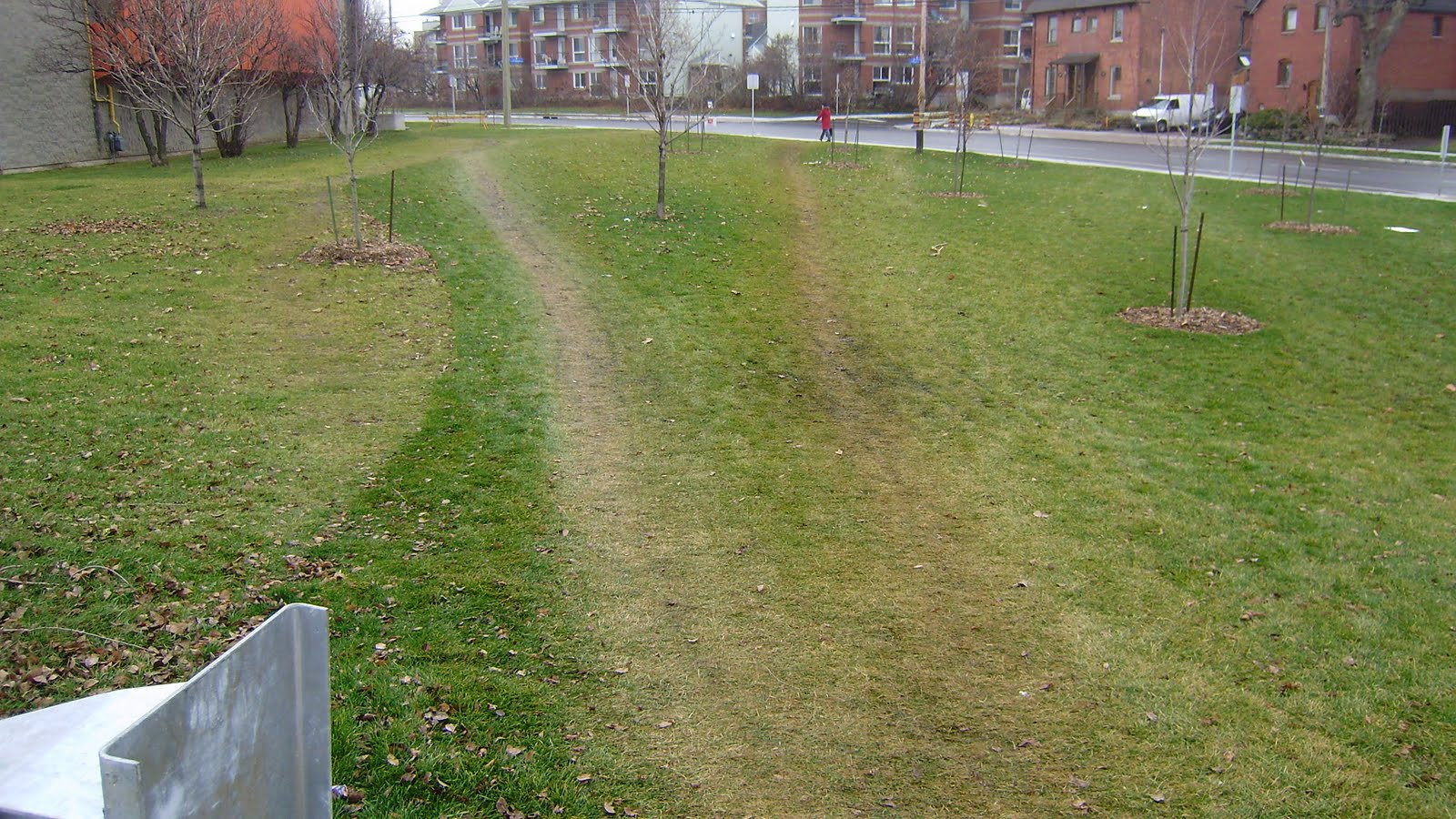
The City is pretty much finished its reconstruction, streetscaping, and traffic calming work along Bayview Avenue near Scott. The picture above is of the recently sodded field between Tom Brown arena and the Bayview/Scott/Albert intersection. The dividing line between the old field (left) and new sod (centre) is obvious.

Notice how pedestrians cut across the field starting right at the end of the steel crash barrier along the road. The barrier effectively discourages many pedestrians from taking even shorter short cuts; as soon as the barrier ends, a few paths appear immediately.

There is a city sidewalk, but it goes around the perimeter of the site, glued to the edge of the road. The city assumes that road geometry = pedestrian needs. That pedestrians have non-road-alignment needs and desires was apparent before the construction (there were paths in the grass for decades!) and the need to pave these to provide a safer walking environment was identified in community planning documents.

Why doesn't the City pave these paths to meet pedestrian needs? Mostly I think it is a mind-set issue. The City provides roads for the convenience of motorists, and pedestrians are a nusicience add-on only. There may also be a maintenance issue: if the city acknowledges these paths by paving them, it needs to plow them and this requires paths that follow a plow-able geometry. However, by ignoring what are obviously well-used paths, I think the city opens itself up for liability issues in that it is ignoring what it plainly must see before its face. It cannot hide behind the figleaf of deliberate ignorance.

Thursday, November 19, 2009

Paying for Water Etc.

Ken Gray over at The Bulldog blog cites the following from a Conference Board study:  "Water charges based on the value of property-or any other fixed measure that is not directly related to water consumption-cannot provide consumers with clear price signals," said Len Coad, Director, Environment, Energy and Technology. "A cultural shift is required in how we manage our water system. Instead of relying on the tax base and allowing users to pay a below-cost price, those who use the service should pay the full cost of water, including capital expenditures."

I agree fully. The genius of our society is the marketplace, where prices are set and goods and services supplied to those who buy them, rather than according to political fiat. Governments are too often in the habit of taking over a market, screwing up the pricing to meet some social / political goal, making themselves a monopoly and then generating "rent" (excess prices paid to the owner or inefficient distribution including rent to labour). As "water bills" become sources of general revenue, they lose their value as price signals.

Piling on is another risk. That's when your supplier claims to charge you for the service but adds on other services that are unrelated. When the City rebuilt the playing fields at Pouffe Park a few years ago, they seeded the fields and kept soccer teams off them for one or two years for the grass to establish. Sod was prohibitively expensive, the City claimed. Then the Preston reconstruction came along, and the fields had to be lowered 3' to serve as emergency storm water storage areas. They were excavated, and then sodded (an operation detailed in earlier posts to this blog). Why was sod affordable second time around? Because, I hear, it was paid for by your water bills and not the City's general revenue. Scrutinized expenditure is more frugal than unscrutinized expenditure.

And what of the curbs, bulbouts, fancy paving and plantings of streetscaping efforts along Preston, West Wellington, Bayview, Albert, and Richmond roads? Are they just "restoring" the surface as part of a sewer and water project? Obviously they are significant upgrades. Is the City is fobbing off urban expenditures from the general taxpayer city budget to the water users?

Here are some illustrations of the restoration occuring after water works are done:

Prior to recent water works, this part of Breezehill North was narrow, had no curb, no sidewalk


Slidell Street where it meets the Ottawa River Commuter Expresway. Prior to water main replacement, it had no curbs or landscaping.


Bayview north of Scott used to have a partial sidewalk on the west side, now the street is rebuilt to a higher standard.


I like the new landscaping and streetscaping being done on these projects. I like the traffic calming, the bulb outs, the new streetlights, the tree planting, the snuck-in bits of bike path. But how many things are being snuck in that are harder to notice, like wider turning radii at corners to handle larger trucks on inner-city streets? Or intersection "improvements" that facilitate car travel at rush hours? What sort of stuff is being slipped into water projects in other neighborhoods, good or bad? I'd rather see the water bills pay for water infrastructure rebuilding and restoration to the existing standards, and "upgrades" charged to the appropriate  City budget.

Saturday, November 14, 2009

Gates of Lemieux Island re-installed


The access road to Lemieux Island water plant has been badly torn up for the construction of the high pressure water mains to the Island. Finally, the road is reappearing, although as you can see from a careful examination of the photo the new road is relocated to the left. During the construction, the ornate gates -- which look like they belong to Her Highness the GG instead of here -- were removed and this shows the eastern side gate and pailings reinstalled.

Tuesday, November 10, 2009

Dalhousie Community Assoc responds ...

Wearing my other hat, and with much input from other members of the Dalhousie Community Association board, the DCA sent two letters. One to the Marie Lemay of the NCC regarding the bad idea for bringing Rapibus to Ottawa over the POW bridge; and the other is detailed comments on the current state of the Downtown Ottawa Transit Tunnel study.

You can read both of these letters at http://www.dalhousiecommunityassociation.blogspot.com/

Monday, November 9, 2009

NCC to Quebecers: Back [on the] Bus

 
Proposed modernist Bayview LRT station is elevated and long. The proposed STO bus terminal would be off the left. Click to enlarge photo.

Planning in a Federal capital region is not just about good planning on utilitarian "planning' terms. A good chunk of it is political planning and symbolism too.

In the past,  separatist elements in Quebec made hay from the disparate images of the Quebec side of the river (low rise, lower income housing, industrial mills) and the Ottawa side of the river (shiny high rises set high on a green hill). They drew a direct line to the federal purse, discrimination, second class status, etc.

The response from the Feds was politically / symbolically motivated. The Portage Bridge appeared, the Ottawa River Parkway was rerouted so that Wellington appeared to go directly to Hull while Ontario users had to "turn" to continue in Ontario. High rise cubicle farms sprouted on the Quebec side. Museums and prestige buildings materialized. Confederation Boulevard.

The major planning decisions for roads, transit, and buildings, in the Ottawa-Gatineau area have traditionally had a strong Federal political element.

Today, I fear the Feds are about to step in la merde in a rather big way.

Ottawa planned and built its transitway (bus rapid transit, or BRT) a few decades ago. It was a reasonable decision for the size of the city as it was then. It was always designed to be convertible to LRT, which is where we are heading now. On the Quebec side, the City is now planning and constructing its own BRT system called Rapibus. I presume that Gatineau is making a rational decision given its population density, geographic area, costs, etc.

The problem comes in the downtown area where the two systems -- LRT and BRT -- will meet.

There is currently a front-running proposal in the NCC-chaired interprovincial transit study to bring the Rapibus system over to a terminal in Ottawa. If the Prince of Wales railway bridge is rebuilt as a two-lane BRT for STO buses (a repeat of the Alexandra Bridge solution adopted almost half a century ago) the national unity optics are terrible: English commuters ride sleek and shiny LRTs to the downtown, French commuters ride old-technology diesel buses to the periphery where they are then permitted to transfer to the LRT.

Election 2020: If I were the PQ, I'd be snapping pictures of the two modes from an aerial point over the Ottawa River looking south, ie the view from Quebec. It would show the Federally-funded bright red trains entering the modern very long elevated glass and steel Bayview Station, and Quebecers shuffling past bus shelters on their traipse through wind-whipped snow to get to first class transit.

Of course, the national unity side could score with a slightly different system: build the LRT line over the POW bridge to stop at Terrace de la Chaud and then run along the surface of Rue Principale to Place du Portage. Then the picture shows Federal money delivering the smart-growth green technology of the future to the voters of Quebec. I'd even paint the LRT vehicles on the first part of this great circle loop in STO colours, regardless of who operated them.

Which picture will the NCC be setting up?

Friday, October 23, 2009

DOTT plans affect west side residents (xi): BikeWest

The city cycling plan includes conceptual improvements for cyclists heading west from the core towards Westboro. Councilor Leadman is fighting for improvements to the ill-designed Scott Street mixed-use path and a connection to the downtown. Cycling advocacy groups want better cycling facilities. The BikeWest plan proposes a segregated bi-directional cycling path on the north side of Albert and Scott from the downtown (Bronson Ave) to Westboro.

One of the original purposes of the BikeWest plan was to tie into all the construction projects planned along the Albert-Scott corridor. It is important not to construct anything that permanently blocks cycling improvements, even if the cycling improvements are not yet being built. It is also economic and thrifty to tie in cycling path improvements to new major road and LRT works planned along the corridor.

Working from the downtown west, the currently proposed DOTT plan does not adversely affect BikeWest between Bronson and Booth. It remains to be seen if city planners can be convinced to include BikeWest either along the north side of Albert or along the new grade-separated LRT alignment. The intersection of Booth at Albert remains a horror for local residents and the new intersection plans make it worse. It remains to be seen if the intersection can be scaled down, single-occupancy car motorists tamed instead of catered to.

In the latest DOTT plans the Preston extension will be built very early in the LRT construction process. This opens a few opportunities to facilitate the cycling experience in the E/W and N/S direction. It all depends on the willingness of council to direct that cyclists be treated seriously. However they design this road feature it is unlikely to create insurmountable cycling problems.

The Bayview Station design calls for a huge widening of the current transitway bridge over the OTrain cut. It would be economic to widen the bridge a bit more to include a segregated bike path beside the new station platforms. This would overcome the biggest hurdle for westbound cyclists: getting over the OTrain tracks. The current Albert St alignment has narrow sidewalks and very fast moving traffic that creates a cyclist-unfriendly environment. It is especially inconvenient for downtown-bound cyclists to get from the Scott path over the tracks to Albert Street.

At Tunney's, cyclists today are supposed to cycle on the north side of the Scott Street sidewalk/bus platforms. For much of the station length this is not a major problem with the current bus passenger volumes. However, when Tunney's becomes much busier it will be a major difficulty. Unfortunately, the current DOTT plan continues the unsatisfactory cycling-unfriendly  arrangement.

It is possible to do much better, and cheaply too. Recall that the new platform shelters for the LRT deep in the cut, will have roofs level with the ground at the Scott Street side. The City proposes a "green roof" here. They also propose widening the pedestrian overpass by 3x, while keeping the current elevator shafts, stairs, and exit buildings. It would not be difficult nor expensive to use the LRT platform roof as additional pedestrian areas, with entrance doors directly onto the new widened pedestrian bridges. This would reduce or eliminate the current exit that opens directly onto the bike path. While not ideal, since pedestrians would all have to cross the bike path at grade to get to the bus stops, it would be an improvement over the current plans.

Even better would be for the planners to sit down with cycling advocates for a few hours to hash out some ideas for reducing conflict. Note that the conflict with the sidewalk and station exists whether a bi-directional segregated bike path is built per the BikeWest model, or a uni-directional path is built along the edge of Scott Street itself. Opportunity knocks, will cycling be given a boost or a permanent block?

Thursday, October 22, 2009

DOTT plans affect west side residents (vii): Bayview Rapibus Station?

The City has been evaluating the structural soundness of the historic Prince of Wales Railway Bridge over the Ottawa River to Gatineau. The City bought it a number of years ago for transit.

Friends of the OTrain and  LRT transit proponents have long viewed the POW bridge as a great solution for taking transit across the River. The interprovincial transit study offered renewed hopes for extending LRT service from downtown Ottawa to Gatineau over the POW as the first phase of a loop system serving the two downtown employment centres and to alleviate bridge congestion. Alas, logic may be loosing out to other concerns.

I gather that a leading proposal for addressing interprovincial transit woes is to widen the POW bridge to a two lane transitway (not LRT or OTrain) to bring the Rapibus system (Quebec's new bus rapid transit system just like Ottawa's 25 year old transitway) over to the Ottawa shores. A transfer station and bus storage area would be constructed under the new Bayview Station, connected by elevators to our E-W LRT line. The Rapibus terminal would be in place until such time as LRT was extended across the River. Of course, building a new terminal and widening the bridge * will work to delay that day by at least a quarter century.

 I dislike the idea of building a bus parking lot on valuable LeBreton and Bayview Yards development lands. Extending the LRT across the river and having it service a transfer station on the Gatineau side and having a terminal station at Place de la Chaudiere makes more long-term sense to me. The interchange at Bayview would then be much smaller, more efficent, and technologically advanced. Has the interprovincial study really gone so far "off the tracks" and gotten stuck in bus mode?

* I hear rumors to the effect that the existing POW bridge is in really bad shape, and may only be worth the scrap value of its steel, and that to extend either bus transitway or LRT service from Gatineau will require a totally new bridge. In any case, double tracking it, converting/widening it to two way bus way, or building a new bridge altogether will be very expensive. Mind, a bike and pedestrian link along the bridge would make for a wonderful new link in the bike network.

DOTT plans affect west side residents (vi): Bayview Station revised

Currently the transitway passes over the railway tracks at Bayview with a simple high level overpass. At the east side, it widens for the Bayview station, which is built on a downslope into the LeBreton Flats area. The only access to the Bayview transit station or OTrain station is from the east side of the overpasses.

Passengers can transfer to the OTrain tracks which are on the east side of the railway right of way, simply by walking down the sloped asphalt paths (being careful not to fall off the broken up edges of the path). Recall that the OTrain service north terminus is at Bayview.

The transitway will be converted to LRT use. Earlier plans showed the new LRT station located roughly where the existing transitway station is now located, but with slightly revised elevation and alignment. The new plan proposes major changes to that scheme. The existing transitway overpass will remain in place, but will be widened by about 20' on EACH side, and the station will be on this elevated structure directly over the OTrain cut.


The west end of the station will be on the existing embankment with elevators down to the new OTrain platforms that would be relocated to the west side of the cut, about 100' west of the current OTrain platforms. Presumably the west end of the LRT Bayview station would also have access onto Scott Street, although this is not yet shown (plans are not fully developed). The Otrain platforms are being moved west to open up the area under the overpasses for future LRT construction and possible Rapibus terminal.

The east end of the station will be on the embankment where the current transitway station is now. However, the embankment itself will be gone, replaced with an elevated concrete structure to hold up the tracks and station. Pedestrians will walk over a pedestrian bridge from Albert Street to a mezannine level under the tracks, and then up escalators to the side platform station. Or, from the mezannine, they could go down one level to the future LRT station for the north/south LRT should that be built (currently converting the OTrain line to LRT service is phase 3 of the LRT system buildout). Until the N/S LRT is built, or LRT service is extended to Gatineau via the Prince of Wales Bridge, they may be going down to a Rapibus terminal instead.

The new station location preserves and serves all the necessary options for LRT service to Gatineau, to the south along the OTrain alignment, and east-west. It permits transfers and continuous service by the same LRT vehicles from the downtown to points north, west, and south. It seems a logical design, if expensive and years ahead of living up to its major full potential.

Given that so much bridge widening will be necessary at Bayview, it is time for cyclists and community associations to lobby for improved cyling access from the Albert Street rights of way to the Scott Street corridor rights of way. The simplest thing is to widen the transit bridge on the south side to include a bi-directional segregated bike route. If this link is not built (and during transit construction is the best time to do it) then the dreams of efficient and safe cycling from the west to the downtown will be thwarted as there are no plans to widen the Albert Street overpass over the cut.

DOTT plans affect west side residents (iv): closing the transitway during construction

The new LRT line runs along the existing transitway alignment, with some slight variations. During the construction period of 3-5 years that transitway will have to be closed to buses to permit construction of the new LRT stations and tracks. Where will the buses go?

Earlier plans by the city to move all the transitway buses onto Scott and Albert, starting at Tunney's Pasure, have been abandonned. Thankfully. The additions of 1000 buses per day per direction on Albert and Scott would have horrendous social and environmental impacts.

Instead, the City is proposing to totally rework the bus routes that currently use the transitway. Some will be shifted onto the Ottawa River Commuter Expressway. A temporary bus station along the Parkway at Tunney's is being considered. Other buses will be diverted to the Queensway and Carling Avenue. It is unclear what routes these buses would then take into the downtown core. The Parkway buses for example may take the Parkway/Wellington all the way to the core, or may exit the parkway at Bayview and switch to Albert, which will be unpopular with Dalhousie residents. Of course, many buses will still be diverted onto Scott/Albert  as that route directly parallels the transitway. Planners see an advantage in having commuters see the progress as the new LRT line and stations are being built. We know there will be intersection widenings and new stack lanes at Preston, at Booth, and possibly at Bayview. Will buses on the Qway exit at Rochester to head downtown? Will Carling buses be added to an already congested Bronson (which will be partially closed and rebuilt over the 2011-2012 construction seasons).

Traffic engineers have a thankless task during the construction period. Buses cannot simply be moved onto Scott/Albert, the road cannot handle the volume. So the bus traffic detour "pain" will be shared by a number of neighborhoods. A bus commuters will also suffer as more routes means a lower level of service on each route, and lengthier commutes.

Note that construction of the tunnel itself from a point just east of Booth will not interrupt transitway service much. However, the construction of the LeBreton, Bayview, and Tunney's stations are complex and lengthy. We can expect continued transitway service as far as Booth for the first two years of LRT construction, then the bus commuters will be detoured elsewhere for the final two or three years of construction for the tracks.

Tuesday, October 6, 2009

Lansdowne Live

Some misc observations on Lansdowne Live, and in particular the meeting last night at arena Tom Brown arena.

1. Opponents are well organized, sporting custom printed apparel and carry bags (made of recycled hemp, I hope) and handing out reams of photocopied green paper that may have required the souls of every tree in the Glebe. Of course, the Glebe trees are still there (at least along Ralph and Percy when I walked up those streets yesterday) so trees from some other place were sacrificed. Sacrificing somewhere else seems a common theme.

2. The green shirters took off their shirts to sit among the audience or ask questions at the mike, at last night's Live meeting, thus appearing as 'unaffiliated' citizens when they hissed and boo'd answers and people they didn't like. As the meeting ended, the team uniforms were pulled on again. We require lobbyists to register so we know who is meeting whom, it might be nice if citizen lobbyists for one particular cause did the same by keeping their shirts on. (I wore a sweater and jacket throughout the meeting, the air conditioning worked well and continuously despite the crowded room).

3. Cullen, running for mayor, repeatedly referred to Bayview as the best site. He did not mention any alternative sites, certainly none in the Glebe or Ottawa South. He did not mention whether the local residents should have any voice in the matter. He gave every impression his mind was completely made up.

4. I am amazed at the ability of residents and politicians  to call for consultative planning but conveniently ignore the fact that the Bayview site already has a plan for 1600 medium density housing units and a 300,000 sq ft civic building (envisioned in the 2004 study final to be the library, which is now going elsewhere). But no where was a 25,000 seat stadium mentioned. I reviewed this with city planning staff and other community groups, and they confirm a stadium was not on the books. I also reread the Bayview report. Nary a stadium in sight, despite Martin claiming that residents have been consulted.

5. Getting into the Live meeting at Tom Brown was like running a gauntlet of time share salespeople in Mexico, with hyper-ventilating sales people pushing the merits of their real estate dreams. The alternatives to Lansdowne only look attractive because they are not fleshed out, they are conceptual ideas only, being compared to a detailed Lansdowne plan. Of course it is easy to pick at the detailed plan and fantasize about the vague one. Sell the sizzle.

6. I am constantly amazed at the people - politicians, architects, professors - who use one set of words to tell us why Lansdowne is Bad Plan (parking horrors! ugly stadium! sensitive neighborhood!) but then switch vocabulary when suggesting alternatives such as Bayview (civic structure! pedestrian paradise! transit nirvana!).  Residents of the Bayview area may be lower income than the Lansdowne area but we are not stupid.

 7. I am surprised how many people latch onto flimsy straws that support their views without thinking it through. Parking around Lansdowne - now and in the future - will be a problem. So will transit access. So people jump to the Bayview site as solving all this because its on one or more LRT lines (so would the Carleton site, but hey, that's too close to ... ). Well, Bluesfest is located just a few hundred meters east of Bayview, equally right on the transit line, and the neighborhood was plagued with parking problems as thousands of attendees drove to the event and tried to park on lawns, bouelevards, and park space when they couldn't find free on-street parking in the first block off the site. What will make all these people suddenly decide to take transit to the stadium?

8. People at the meeting derrided the park and ride schemes proposed in the Lansdowne Live plan, saying no one would park at Carleton U ($$) or Billings Bridge (because the mall is open 7 days a week and most evenings). But then, how would transit work for Bayview if people aren't expected to park at Lincoln fields, College Square, St Laurent and other shopping centres to take the LRT? Is the City expected to provide new larger park and ride lots for 24,000 cars? If so, shouldn't we consider where and at what cost?

9. Martin proposes a Bayview stadium that is sunk into the ground to partially hide it. As a resident of the Bayview area, and a walker, I can certainly attest to what planners know but seldom boast about: Bayview and LeBreton are low lying areas subject to cold winds from the west and north. They are, in short, thermal sinks. This might be a contributing reason they have always been low income areas. A sunken sadium would be even lower. Can Mick Jagger say "Brr"; Can Kiss-y cats fluff their fur? Surely outdoor concerts would be more comfortable at Lansdowne.

10. And just where does the Bayview parking structure go? Under the sunken stadium, five stories below the River level? And all those people leaving Bayview in their cars ... are they using the Ottawa River Commuter Expressways, even though using the Driveways is disparaged for Lansdowne? Which is it: NCC roads are usable, or not?

11. When the City first faced two competing stadium bids, I was surprised at how quickly centretown residents ruled out Kanata. Much of this is a knee jerk reaction, an antipathy to suburban development which must be derrided as dormitory land and forbidden to diversify. To my mind, the Scotiabank site was pretty attractive: it's far away from me, residents who move in will know they are getting the open air concerts forbidden to the sensitive ears of downtown residents, and it might be enough incentive to extend the LRT to Kanata sooner than later, so we can get rid of BRT in favour of LRT. And it has plenty of parking already.

12. Will the Green Shirt fiscal-hawks be around when alternative stadium sites are being planned for? Or are they really just opponents of a stadium at Lansdowne disguising their opposition in the guise of fiscal and procedural rectitude?

13. If a stadium is bad for established neighborhoods, such as the Glebe/Ottawa South, why is good for other residential areas? Wouldn't honesty require Lansdowne location opponents to oppose stadiums in other residential or urban areas and favour industrial locations? Alas, no such subtle thinking was apparent last night.

14. Questioners focussed on the long term viability of Lansdowne Live: what will become of the stadium in 30 or 60 or 100 years? The obvious answer is that sole city ownership has proven itself a failure as the stadium is crumbling around itself; the Live plan delivers a cash stream to keep the stadium maintained. Would that people were so concerned with the long-term consequences of all city decisions and expenditures.

15. Three politicans were present last night. Cullen took every opportunity to promote himself and Bayview, although Bayview is far from his ward (maybe that's why...). Kitchissippi ward councillor Leadman was there. She represents Bayview area, but said nary a word pro or con Bayview or even that maybe, just maybe, the surrounding community should be consulted and impacts on the area considered. Such admirable restraint! Wilkinson was there too, and did not embarass herself. Holmes was not there to put in a word for her ward which abuts the Bayview site.

16. The city manger Kent Kirpatrick handled hostile questions with grace and skill and in-depth knowledge. It was in marked contrast to the three politicans present. Kirpatrick for mayor !


Finally, a note on my own personal view: I do not think stadiums are easily integratable into urban areas, anywhere. I think stadiums are a component of a vital urban area that offers diverse entertainments and environments, even though I cannot recall ever attending a Lansdowne stadium event.  I am not adverse to looking at Bayview as a stadium site. I am adverse to being stuck with a stadium because an affluent bureaucracy-savy neighorhood gets a below-mediocre council to suddenly jump off a hot stove onto the nearest, ill-thought-out alternative. If Lansdowne Live is killed, what is the alternative?

Wednesday, September 23, 2009

BikeWest - part iv - Scott Street from Bayview to Dominion


The Scott alignment is much straighter than the riverside path and passes through major residential and employment areas

For most of its length along Scott, BikeWest is pretty simple. The two-way paved surface would be set back from Scott Street whenever possible. At major signalized intersections, the bike route might snuggle up to Scott. Signalized intersections at Holland, Island Park, and Lanark would operate as described previously: through east-west traffic on both the road and BikeWest would proceed on green; all left and right turning traffic that might cross BikeWest would go only on green arrows when through traffic movements are prohibited. This would not unduly delay car traffic, and would minimize the conflicts between cyclists and motorists.


Lots of City-owned room along Scott for BikeWest and new pedestrian walkways

For the minor, unsignalized intersections, the bike route might be pulled close to the transitway cut, and would cross the streets on a raised surface. This sharply raised surface will be self-enforcing to vehicles, which will slow down before going over the hump. With a hump, motorists would be reminded of the cycle route whether cyclists are present or not. There would be at least one car length transition zone between the bike crossing and the Scott roadway, so cars would not get hung up in the intersections. There should be yield signs located at each car crossing of the bike surface, to remind vehicles that they are crossing the bike way and that cyclists have priority.

If the raised bike route crossing intersections arrangement fails to get past City hall bureaucrats and naysayers, it will be back to level crossings similar to the picture below, but with better alignment and hopefully a coloured asphalt path crossing the road to reinforce the presence of the bike route.


Current Scott path meets cross street: a mess that discourages path use

The preferred set-back / raised crossing is not perfect. Nothing short of a fully-grade-separated route can be. But most of these unsignalized streets are low volume local traffic roads. Signage would be required reminding motorists not to queue up blocking the bike route.

Exactly how the BikeWest route would bypass the bus transfer stations at Tunney’s and Westboro can only be determined when design criteria for these stations has been decided on.  The bypass need not be difficult or expensive or dangerous. But it needs to be designed into the stations right from the beginning. For example, the current arrangement at Westboro Station locates the bus bay well off Scott Street, letting cyclists continue along a painted shoulder. This is better than the Tunney’s arrangement that forces cyclists to mix with pedestrians and waiting bus users in the same area. Recall that both these stations will be redesigned as part of the LRT project and modifications/provisions for WestBike could be incorporated in the rebuilding.


Current Tunney's Station will undergo major renovation and rearrangment if LRT goes ahead. Could BikeWest be incorporated in the redesign?


Westboro Station. Cyclists either ride on the bus bay or between the island and the road

Once BikeWest approaches Churchill and Dominion, a number of options open up. Many cyclists will percolate south on the side streets that penetrate the residential neighborhoods between the River and Carling. For more dedicated longer-haul cyclists, two options will be explored in the next segment.


Click to enlarge route map along Scott

One key reason why the BikeWest concept needs to be accepted soon is there are a lot of road and infrastructure projects going in along the route in the next seven to fifteen years that can make or break the feasibility of the cycling route. In addition to the transitway and stations, Scott may be rebuilt/realigned, there is a Scott CDP (planning exercise), a Bayview-Carling CDP, and the Interprovincial transit study. The LeBreton concept plan and the city’s Escarpment CDP (covering the area from Booth to Bay) would need to be updated to incorporate the BikeWest concept.


The generous right of way along Scott facilitates BikeWest infrastructure.

Tuesday, September 22, 2009

BikeWest - part iii - from Booth to Bayview


Above: looking west from Preston, approaches to the Bayview Station area

From Booth, the BikeWest bike road would continue as a two-way road separated from the car traffic by a curb and possibly a boulevard, and coloured pavement, with a raised sidewalk to the side of the bike road, all the way west to Bayview Station. Note that the City already owns the right of way along the side of Albert to Bayview, it is where they buried a high-pressure water pipe and where a vague multipurpose paved path was installed two years ago. The path will pass between the existing Dalhousie neighborhood (which includes the first 600 houses built in the 1980's as LeBreton Flats phase 1) and the new proposed higher density mixed-use Flats project currently underway (slowly).

The bicycle road would be adjacent the (north) side vehicle lane of Albert to facilitate snow plowing, but the sidewalk, already raised slightly higher than the new bike road, would be separated from the roads by a boulevard of trees and grass.


Above: the current ill-designed multi-purpose path would be replaced with bi-directional BikeWest lanes along Albert with a new pedestrian sidewalk set back behind a landscaped buffer of trees and grass. Not quite the Champs Elysees, but that’s the inspiration…

At Bayview, Albert crosses the OTrain tracks and joins Scott. The intersection with Bayview Ave is unlikely to change from an at-grade signalized intersection, which would be treated the same way as other signalized intersections as described previously, to provide safe intersections for cyclists without frustrating delays.

The connection at Bayview of the north-south transit line with the east-west LRT line is not finalized. It will most likely involve a station just east (towards the downtown) of the current Bayview transitway station, and will be a major transfer point from the east-west service to north-south service, including service to Gatineau on the existing-but-unused Prince of Wales railway Bridge. As part of this transit interchange, the City may have to widen the Scott Street road bridge or the transitway bridge over the OTrain, in order to improve alignments and handle the number of lanes/tracks required. It would therefore be economical to widen either structure at the same time to accommodate a two-way BikeWest project. Suitable side access to the Bayview station and other routes (such as the NCC Ottawa River bike paths, and the southwest path along the OTrain right of way) should be incorporated into the Bayview area design.


Click to enlarge: BikeWest route on north side of Albert


After leaving the Bayview Station area and crossing Bayswater Road at grade, BikeWest would continue west using the greenspace along the north side of Scott Street, where an existing multipurpose path would be rebuilt as separate landscaped BikeWest and pedestrian paths. Whether the path is located adjacent the north road curb or set back in greenspace is subject to discussion and refinement, but either can work with the BikeWest concept.

Note that a key to the success of the BikeWest concept is that commuter cyclists have direct dedicated path westward. This will remove many of them from the meandering NCC riverside paths, thus obviating the demand to build separate pedestrian and cycling paths along the waterfront.

At every major intersection, BikeWest users would have the same length of green lights as would car traffic, ie not be second class to car commuters. The bike road will not be successful if users are frustrated by car-priority signaling at intersections or unpredictable, potentially fatal cross-traffic. Thus the emphasis that BikeWest users have the same green lights for through traffic as cars do. (Recall that traffic turning across the BikeWest route does so only on right turn/left turn arrows, from separate stacking lanes (most of which are already there) so car traffic does not cross the bike route when cyclists are proceeding through the intersections. Like all signalized intersections, obeying the signals promotes everyone’s safety.

BikeWest is not just for commuter cyclists though, which is why connections to other City bike routes and the NCC recreational paths are necessary to help construct a web of safe cycling routes in the city.

Next: segment 3, from Bayview to Dominion.