Showing posts with label Bronson. Show all posts

Tuesday, August 3, 2010

More on Bronson's fake trees

I had thought Ottawa was perhaps unique in wanting to install fake trees on concrete foundations along Bronson rather than plant real trees with real roots.

The City is reconstructing Bronson next year. In their rush to pave over every possible inch of Ottawa space for rush hour commuters to head over to the greener pastures of Pointe Gatineau or out to Greely, they discovered they had no room left over for pedestrians, cyclists, transit users, residents, adjacent businesses, kids heading to school or grandma heading to the lawn bowling club. No room for bus shelters, benches, or trees ... so the City proposes installing fake trees, as they don't require room for roots to grow, are immune to salt, etc. See the second illustration below for a sketch of the proposed artificial foliage, and don't forget those yellow and red cars are speeding along at 70 or 80, and the benches are on private property only if the owners cede the space to the city.


I had thought Ottawa was perhaps unique in wanting to install fake trees on concrete foundations rather than plant real trees with real roots. Alas, I was wrong. Regina is doing us much better. They are chopping down real trees to replace them with fake trees.

Victoria Park in downtown Regina is being refashioned. Supposedly, work crews digging to plant trees discovered lots of gas mains, wiring, etc in the area (who knew!?) and so the City is proposing "shade screens -- large metal frames of self-weathering steel that will rust to a durable orange-brown, linked with curving reflective strips of shiny aluminum" (National Post, pg A6,"Residents liken park design to Nazi camp").

The story goes on to describe residents as "disillusioned by the loss of trees and ... an emblem of tradition lost to modernism, and of nature lost to the city".

There are a couple of themes here worth pondering upon. One is the desire of City departments to get rid of real trees, with their inconvenient growth and variability and seasonal change. We have seen our cities steadily remove all large trees, and now apparently the small ones have gotta go too.

The other theme is the underground utilities. On Bronson, for example, we requested the City require new and reconstructed utilities be burried deep enough so trees could be planted. Oh, the looks of horror on their faces ... they had no intention ever of requesting let alone requiring utilities be located more than 36" deep. The role of landscaping was to fill in the left over spots, if there were any. That a street might have stakeholders or influence other than for utilities and commuters was unthinkable. Such unthinking gave us ugly Bronson in the 50's and such unthinking still prevails with (some) city staff and consultants today, over a half century later. Ugliness and disutility designed in from day one.

Tuesday, July 20, 2010

More on Bronson Road Diet

This morning the CBC did a follow up interview on the problem with Bronson. They interviewed Dan Burden, who is a leading proponent of road diets. I have used his materials in suggesting to the city that Bronson needs to be put on a diet, and their answer, without any justification, is always ... "no".

You can listen to his interview here:  http://www.cbc.ca/ottawamorning/
Select the story called "road diet". He points out that some cities are already up to their thirty-third road being put on a "diet" and dear old Ottawa won't even consider putting one road on a diet. Sigh.

Monday, July 19, 2010

Bronson road diet

Your blogger was interviewed on CBC radio this morning about the Bronson issues. He was also a news story in the local news lineup. You may be able to hear the interview by going to
http://www.cbc.ca/ottawamorning/

and selecting the "fake trees" item.

The story must have gotten some feedback, since they followed up looking for additional people to interview in the coming days on the subject of road diets.

Wednesday, June 16, 2010

Bronson deja vu all over again

Last night was the second PAC (Public Advisory Committee) meeting on Bronson. After the hard time the city planners and consultants got at the first meeting in April, the May meeting disappeared in favour of a mid-June date.

The city and consultants got ideas from the public (me: the Bronson 2 lane plus two way left turn lane model) and the community associations (2 lanes plus turn lanes at intersections, a livable streets model that has worked so well for fixing roads with similar volumes in Toronto) and a lot of pressure from the Councillor to do better.

So they came out in full force last night. The city or the consultants hired more consultants to review their work (guess what: given the same marching orders and look-up tables, they came up with the same results -- well, duh!). They dragged out a planning junior who offered to stand at intersections with PAC members to consider how to improve ped movements -- if feasible and not interferring with car traffic flow. They brought in a landscape architect with large maps with huge coloured blobs on them identifying areas for pedestrian improvement and landscaping -- many of the blobs were on the paved road surface which is not exactly ped amentity space.

To cut to the nub:  the city inisists Bronson must stay as four lanes all the way through, no alternative configurations can be examined.

They did claim to abandon their prior suggestion to widen Bronson by at least 2'. Well, sort of. In an effort to promote consistent lane width, they would still widen Bronson in the area south of Gladstone; and in the north portion of the street where there was more land available, they proposed chewing away at adjacent green space to make the road lanes 35% wider than elsewhere. Mere details. 

Our planning politburo continuously chanted that their priorities were peds and cyclists first, transit, then private cars. Even the most naive participant would have a hard time swallowing that. For example, their ped first plans didn't quite allow for consistent minimum width (2m) sidewalks:  near Gladstone that meant sidewalks combined with bus stops combined with traffic signals and wooden utility poles would be a princely 1.5m wide.  On a busy corner. With the commercial storefront door also opening onto the sidewalk. Better hope those pedestrian hordes are real friendly. And turning cars don't cut too close.

The city planners rushed through the traffic and lane width stuff at breakneck speed, anxious to get to the brightly coloured dots (three colours! -- but alas no daisy shaped flower dots like I wanted) and magic markers (many colours!)
with which the remaining PAC members were to mark up big road maps with "suggestions" for consideration and implementation "where feasible" after "review by the TAC" (Technical Advisory Committee, ie the traffic engineers).

The landscaping proposals were somewhat attractive but severely constrained. Nice architectural drawings (planning porn) of benches and planters were shown, but won't actually be built along Bronson -- all the space has already been taken up by the pedestrian priority car lanes. Instead, they will be located on private property set back from the sidewalk where private property owners are willing to sign legal contracts permitting the city to do so. No word on how many of these planters and benches we might actually see, and many PAC members expressed scepticism that absentee landlords would ever consider these. Would even quasi-public landowners be intersted? --  the community minded Bronson centre itself has been busy removing trees each year and expanding the car parking zone in front of its building.
Double click to enlarge. The top two views illustrate a typical section of Bronson. Don't forget the car is speeding along at +60. The ped light is on the curb line, which is good. The proposed tree is on private property, if permission can be attained. The lower drawings show proposed treatment where parking lots abut the sidewalk. The planter and tree are on land cheerfully ceeded by the property owner who didn't mind the loss of revenue space.


The plans also showed lots of trees along the sidewalks -- of the side streets. These were shown based on the assumption that the Bronson reconstruction project would allow them to be planted there, as they were outside the current bounds of the project mandate. Oh dear.
\
But on Bronson itself, there wasn't room for any trees. So the architects proposed mechanical trees, artificial trees, that would be "planted" along the curb line with mechanical shading devices for peds. In the pix, they look sort of like those big plastic banana leaves you can get at IKEA to decorate your kids room. The tree trunks will help separate peds from cars.
Double click to enlarge. The top illustrations of are of benches, planters, brick pavers and other "landscape integration opportunities" all of which are on private property provided by willing and eager property owners. The bottom illustrations are of the bus shelter (also likely located on private lands) and the "architectural feature" are the artificial trees that substitute for the real thing since the pedestrian priority plans lack space for much of anyting except roadway.


It wasn't all bad at the meeting though. Staff and consultants were eager to be nicer than they were at the first meeting. They agreed to ped lighting along Bronson, with the posts located on the curb line (this is important as it restricts the apparent lane width, promotes subjective ped safety, and goes against the engineering view that the street and sidwalk should be one large open space for the safety of motorists and convenience of winter snow removal).

They proposed coloured concrete paving in the major intersections (easy to do! economical! they do it all the time!) even though that idea went down in cost and maintenance flames when studied for four years on Preston. Sidewalks will be made of concrete, perhaps stamped with a pattern, because interlock pavers like used on West Wellie, Richmond, Preston and other west side sidewalks "just won't stand up to our climate and heavy sidewalk plows and will look awful in ten years" (on this I share some sympathy: the city frequently demonstrates it is unable to maintain interlock pavers, whereas poured concrete is pretty simple stuff).

Summary: Car commuters to Pointe Gatineau win big. Peds get some lighting and fake trees. Adjacent land owers might get their front properties relandscaped provided they are willing to give up the space. Cyclists get nothing. PAC gets to hear more "mights" and "where feasibles" than normally treated to. Sidewalks get rebuilt, sometimes narrower, a few times a bit wider provided the room can be appropriated from green space. Decorative overhead wiring will stay on this "scenic entry route" to Ottawa.

C'est la vie in Ottawa.

Friday, June 11, 2010

Another Bronson Plan

Members of the Dalhousie and Centretown community associations met to create a suggested Bronson layout that would be a first step to creating a more liveable street.  Here are my notes on the proposal for a new Bronson between Albert and Gladstone:

 Drawing up a plan by ourselves has certain disadvantages -- we cannot estimate turn lane lengths, for example. But we are suggesting these things to the planning group in an effort to get started on a plan that might, with tweaking, be acceptable to the neighborhood and many stakeholders.

First, let's differentiate this plan from the one recently outlined on posts last week on this WestSideAction blog. That plan, for 2 lanes of traffic with a centre TWLTL (two way left turn lane) was developed because I had the traffic literature and volume data to back up the suggestion, ie, I know it will work.

The plan we suggest now is one we have not had time to find traffic literature to support, but there are enough similarities to the 2+TWLTL that we think it will handle the same volume of traffic while delivering more neighborhood benefits. At this point it should be pointed out that while we target handling the current volume of road traffic on Bronson, we by no means consider this sacred: the city is growing, it cannot endlessly stuff more traffic onto Bronson, at some point, it's a "no more" situation, and we see no reason why the volume last week is more defensible a upper limit than a volume some day in the future. If the redesigned road handles slightly less traffic, or with slightly more delays, so be it.

The basic outline of the plan is as follows:

  • reduce Bronson to two through lanes, with additional left turn lanes at signalized intersections such as Laurier, Primrose, Somerset, Christie, Gladstone. This should handle the current volume without delays.

  • in between these three lane sections, introduce one parking lane, probably on the west side (as there are fewer intersections on that side)

  • only the two through lanes to paved in asphalt, parking bays to protected by curb extensions with trees and utility poles such as light fixtures. Parking bays to be paved in interlock pavers or textured pavement so there is a clear and consistent message that this is a two lane road and not a four lane road interrupted by bulb outs

  • this 2 lane plus parking bay layout will permit the widening of the side boulevard by at least two feet on each side of the road. Coupled with paving sidewalks right back to the property limit, we will achieve wider sidewalks plus room for curb-side planting of trees at 12-16' centres

  • an experienced landscape consultant needs to be engaged to plan a very aggressive tree and shrub planting scheme including the city aggressively incorporating the adjacent dead spaces between most buildings and the front lot lines, ie on private property

  • reduce the posted speed limit if required to accomodate a tighter built environment and traditional main street character

With respect to lane size, the two traffic lanes should be of the city's standard width for vehicles plus cyclists in mixed traffic. We are not suggesting a painted bike lane. The turn lanes should be of a standard vehicle width without extra space for cyclists as cyclists in the turn lanes should "take the lane" if mixed with traffic, or if less confident, pause at the far side of intersections and turn 90 degrees with to stay on the curb edge.

We suggest that in this plan, funding be set aside to improve the parallel low-traffic-volume on-street cycling facilty. In particular, consider making Percy Street a two-way cycling facility with southbound cyclists mixed with traffic on sharrow-marked streets, and northbound cyclists in a painted counter flow lane along the east curb that is well marked as a no-stopping zone.


Obviously, there are many details to be worked out, but we are attempting to address the most salient issues so that this plan can be drawn up and considered as a credible alternative to the current unsatisfactory four lane carbuncle now in place.

Here are some more specific suggestions for designing this street as a two lane street:

 Bronson/Albert:  on the NW corner, widen the sidewalk right back to the property line with a retaining wall by the Juliana (consider purchasing additional land here to widen the sidewalk another 3') and directing the sidewalk to vear NW (using some of the park space here, a stone retaining wall to hold up the sidewalk will be necessary) to align with the path on the west side of Commissioner; landscape lushly as this is a key pedestrian/cyclist link into the downtown core.

all one-way side streets approaching Bronson to be of the latest one-lane standard widths with lengthly curb extensions on the side streets (the current streets are a mish-mash of widths and many are too wide; the idea is to clearly signal that motorists have entered side streets and are not on cut-through arterials

all east-west crosswalks at all signalized intersections to be scored poured concrete; all north-south crosswalks at side streets and Primrose and Christie to be light-coloured interlocks

to reinforce the main street character and promote main-street style redevelopment, all Bronson sidewalks to be brick or coloured pavers, with appropriate celebratory fixtures at intersections

when laying out utilities, try to position manholes not on crosswalk locations; and fire hydrants not along the parking bays

Of course, there will be much consultation expected with respect to landscaping, ped lighting, overhead lighting, tree locations, etc but for now the above material should be sufficient to layout a street geometry for consideration by the traffic engineers and the larger community.

Recall also a previous suggestion that the road be restriped in August in the new layout for a trial period before reconstruction begins.

Sunday, June 6, 2010

The Bronson diet literature

Bronson today


Example of an after diet road: two through lanes, centre turn lane, bike lanes, usable sidewalks. Could be improved by adding trees to the boulevard.

If you are keen on reading more on putting "four lane" roads onto a two lane diet, start reading here: (note that some references take you to same key documents, but there are references to new sources at each of these)


http://www.congestion.kytc.ky.gov/roaddiets.html

http://www.walkable.org/assets/downloads/4%20Lane%20Conversion.pdf

http://www.walkablestreets.com/diet.htm

 http://publications.iowa.gov/2888/

http://www.mnltap.umn.edu/Publications/Exchange/2008-3/ResearchAnalyzes.html

http://www.urbanstreet.info/2nd_sym_proceedings/Volume%202/Knapp.pdf

http://www.iowadot.gov/crashanalysis/pdfs/ite_draft_4to3laneconversion_papersubmission_2005.pdf

There is lots more literature out there. Google "the conversion of four lanes", or "road diets" to get started, and follow the links and citations in the articles. There are many many references to cold climate, snow climate, and Canadian city examples cited. And there are many studies on streets with a similar profile and even much higher traffic volumes than the section of Bronson north of Somerset.

Bronson south of Somerset

  What can be done south of Somerset? So in this post, the Somerset to Gladstone stretch.

South of Somerset the traffic count goes up. Recall that the Laurier to Somerset section had 16-20,000 AADT (annual average daily traffic) with under 4% trucks. South of Somerset, it increases  to 21-26,000 AADT with almost 5% being trucks (2003 and 2008 traffic counts).

This is still within the "normal" band of volume suitable for converting a four lane road into a three lane road. But it is at the upper limit. I predict Ottawa engineers would be very unhappy trying these volumes (some road diets have worked with volumes of up to 31,000 AADT, but it depends on the number of intersections, driveways, road geometry, etc).

There are measures that can make it possible to convert busy stretches of Bronson from four lanes to three. The key to handling the volume lies at the intersections. Gladstone is a busy intersection. It needs major repair. It is grossly difficult to cross for pedestrians and cyclists, especially going east-west along Gladstone. Would you let your 9 year old walk to school at that crossing?? I didn't think so. How about your 85 year old mother? (the latter may depend on whether you are in her will or not).

Yet to make the stretches of Bronson between major intersections work as three lanes, the intersections themselves have to be set up to handle the volume of traffic efficently for cars.

My suggestion would be to try Bronson north of Somerset as three lanes this summer, by repainting the lanes. When that works, examine how to repaint the section from Somerset to Gladstone in 2012, before actual road rebuilding is done in 2013.  Use the lessons learned from the first summer's effort; and convene a genuine discussion amongst stakeholders at the Gladstone end as to what the problems are there, what the potential solutions are, and send in the painting crews. Paint is cheap; lives are not.

A better variation on the above "timetable" would be to postpone the reconstruction of Bronson south of Somerset by one year. This would give one season (2010) to try the painted option on Bronson north of Somerset; and one year to construct the new road (2011) and a year to observe the new street, its landscaping, wider sidewalks, etc and determine if the correct balance of user interests has been attained (2012).

As for the stretch of Bronson south from Gladstone, I am reluctant to go there. I lack enough first hand knowledge about the traffic flow there at all seasons. I do know from sitting at Harvey's (we retired people get very modest dinners out), it is alternately hilarious and scary to watch the steady volume of pedestrians trying to cross Bronson at Arlington. And I hate crossing Raymond. Or walking under the Qway. And the stretch up to Carling is awful for pedestrians, cyclists, and motorists. While I seldom drive a car, I simply will not try to turn left off Bronson onto Isabella to get to the Qway. Too dangerous.


Note: these Bronson posts have been edited a bit and put into a single word document, which I will send to anyone who wants it. Of course, I have already sent it to Councillor Holmes and the traffic engineers for Bronson. Please send links to your concillor, candidates for office, and anyone else. Then go the public meetings to be held for Bronson and let them know, loudly, what you think.

Saturday, June 5, 2010

Bronson: the great divide

Over at the Spacing Ottawa blog, Evan Thorton has some interesting views on the effect of the difficult-to-cross Bronson. His site even has a movie of Bronson!!

go to http://spacingottawa.ca/2010/06/04/city-plans-to-widen-centretowns-great-divide/

Bronson: getting the diet started

Wonderful Bronson today.


In the first post of this series, I tried to show that Bronson only looks to have two through lanes in each direction, but functions as two turn lanes with lane-swerving through traffic, the speed of which is set by the fastest driver. The engineering literature abounds with case studies and policy recommendations on what to do with this type of bad road condition: narrow it to three lanes.

The most likely approach that the literature recommends for the section from Laurier to Somerset (given the traffic volumes, number of side streets, driveways etc) is to narrow it to two through lanes of traffic, with a common two way left turn lane in the centre. At the end of this series will be some links to the literature so you read all about the many examples yourself, why they work, etc.

Ottawa is in my opinion a very conservative city. I don't see city traffic officials getting excited about narrowing Bronson. They currently seem fixated on the Bronson serving rush hour commuter traffic from the suburbs and other cities at the expense of any and all other stakeholders (residents, landlords, businesses, pedestrians, cyclists, transit users).

Given that our patient, Bronson, has clogged arteries, and some advisors want to stuff him with more fat (more cars) ... how do we get them to try a diet? My suggested answer lies in the proposed reconstruction of Bronson in 2011-2012. Rather than redesigning the street in a new slimmer body of curbs, boulevards, etc in 2011 why not go on a quick diet this summer.

One night in early August, erase the current painted lines that show four lanes. Repaint with two wider lanes that are friendlier to cyclists and through traffic (but don't paint bike lanes yet) and a two way left turn lane that is also generously wide (15').  Just do the section from Somerset north to Laurier, or to Slater if the city feels comfy doing that. Wait and watch. Count the cars. Survey the residents and businesses in October. See if the road can handle the volume safely, and if people are happier.

The traffic engineering literature predicts they will be happier and motorists will drive safer with no delays. If this works, keep it all winter. This diet approach has been proven to work in other northern climate snow cities like Ottawa.

Then, with happy results in hand, finalize the new curb and boulevard designs for implementation in the fall of 2011. The new Bronson would be slimmer, sleeker, with trees on both side boulevards, decorative pedestrian lighting for wider, pedestrian friendly sidewalks. Residents would stop shuddering as they do now at the mere thought of the old Bronson. Accidents would decrease. Travel times would not decrease. Pointe Gatineau commuters would continue to travel through. Landlords will soon see lower tennant turnover. Properties will be fixed up. A traditional main street will get a second chance at life.

All because of a sudden diet, kick started by a new paint job.

Next: south of Somerset


Example of a four lane street turned into 2 through lanes, TWLTL, bike lanes. No on-street parking in this model. The sidewalks and boulevards should be made wider to complete the conversion to a livable street. Ped scale lighting would be nifty too.

Friday, June 4, 2010

Bronson: the choices are stark


Bronson north of Somerset is busy -- at rush hours. Outside the peak commuter hours, the street is not all that busy. But the wide street with four lanes makes pedestrian crossing unsafe. Landscaping is minimal. The housing and apartments suffer from high tennant turnover because of noise and dust. A classic case of urban street in decline. Thus far the city's idea for this street is to widen it.

Looking at the section from Laurier (top of the hill) to Somerset, the traffic volumes are 16-20,000 vehicles per day (the AADT or Average Annual Daily Traffic count). Volumes have not increased between 2003 and 2008.

There is extensive traffic engineering literature that describes what should be done to a four lane urban arterial with this volume of traffic: put it on a diet, narrow it to three lanes.

At first this may seem counter intuitive. How can a busy, congested four lane road be improved by making it narrower? The answer lies in challenging the assumption that it is four lanes, but as demonstrated yesterday, it is really a road consisting of a right turn lane, a left turn lane, and through traffic that lane switches throughout the length. It does not currently function as a four lane through road.

There are two models of three lane roads that are recommended in the literature to replace the awful arrangment currently on Bronson.

Two lanes + turn lanes at intersections: this layout would reduce Bronson to two lanes of through traffic, with the addition of a left turn lane at major intersections (Laurier, Primrose, Somerset). The former curb-side lanes would be used for parking bays, or a wider boulevard with trees, lamps, and wider amenity space that could reintroduce city life to this abused traditional main street. For an example of this treatment, look at Preston.

Two lanes + TWLTL: this layout has two lanes for through traffic (which is more than the street functionally has now) and a centre lane that is Two Way Left Turn Lane. The centre lane is usually wider than the through lanes, and has arrows painted on it to show when left or right turns are permitted. On streets with the volume of this section of Bronson, the traffic literature shows this to be a very safe solution that will reduce traffic accidents, maintain traffic volumes, and drastically increase the satisfaction of road users, residents, and businesses.

The second approach often does not permit on-street parking or even off-peak parking. But the curb side lanes can be wide enough (15') to permit safer cycling, plus wider sidewalks with curbside tree planting to calm the environment.

Next: how to get 2 lanes + TWLTL on Bronson.

Thursday, June 3, 2010

Bronson: the clogged artery


Bronson from Queen Street to Somerset Street is up for reconstruction in 2011 and in the following years the stretch from Somerset to the Queensway. The April proposal from the City consultants was to widen the street and narrow the sidewalks. This was to make the lane sizes match the city's standard lane widths.

The problem with the City's current approach is that it assumes Bronson is a four lane street. And that it is congested. And therefore, the solution is to widen it.

I don't think Bronson IS a four lane street, and there is a whole pile of traffic engineering literature to support my view. Bronson only LOOKS like it has four through lanes. In fact, what it has is a right turn lane, a left turn lane, and through traffic that alternates from lane to lane to get through. Because the street looks wide, it encourages faster movement. The pace is set by the fastest car, which is the guy who passes on the right and changes lanes frequently. All this lane changing makes for fender benders. Cars find it hard to get on or off the street, because of the two lanes of opposing traffic to cut across. Pedestrians and transit users find it really unsafe to try to cross the street. It is not a plesant street to live along or have a business on.

Consider this analogy: Bronson is a patient with clogged arteries. The City's doctor (engineer) sees the constricted artery, and suggests we pump the patient with more fat and gunk since not all of it is getting through. Surely a more reasonable approach is to put the patient (Bronson) on a diet, so that the artery can handle the appropriate amount of traffic safely and without killing the residents, businesses, and adjacent communities.

Tomorrow: how to handle the current traffic volumes

Tuesday, June 1, 2010

Boston transit

One of the newest stations on the red line, near the Charles River, in Boston. The red line is a true metro, with wide cars, third rail, underground in the city but on a grade-separated right of way in the 'burbs and on bridges.


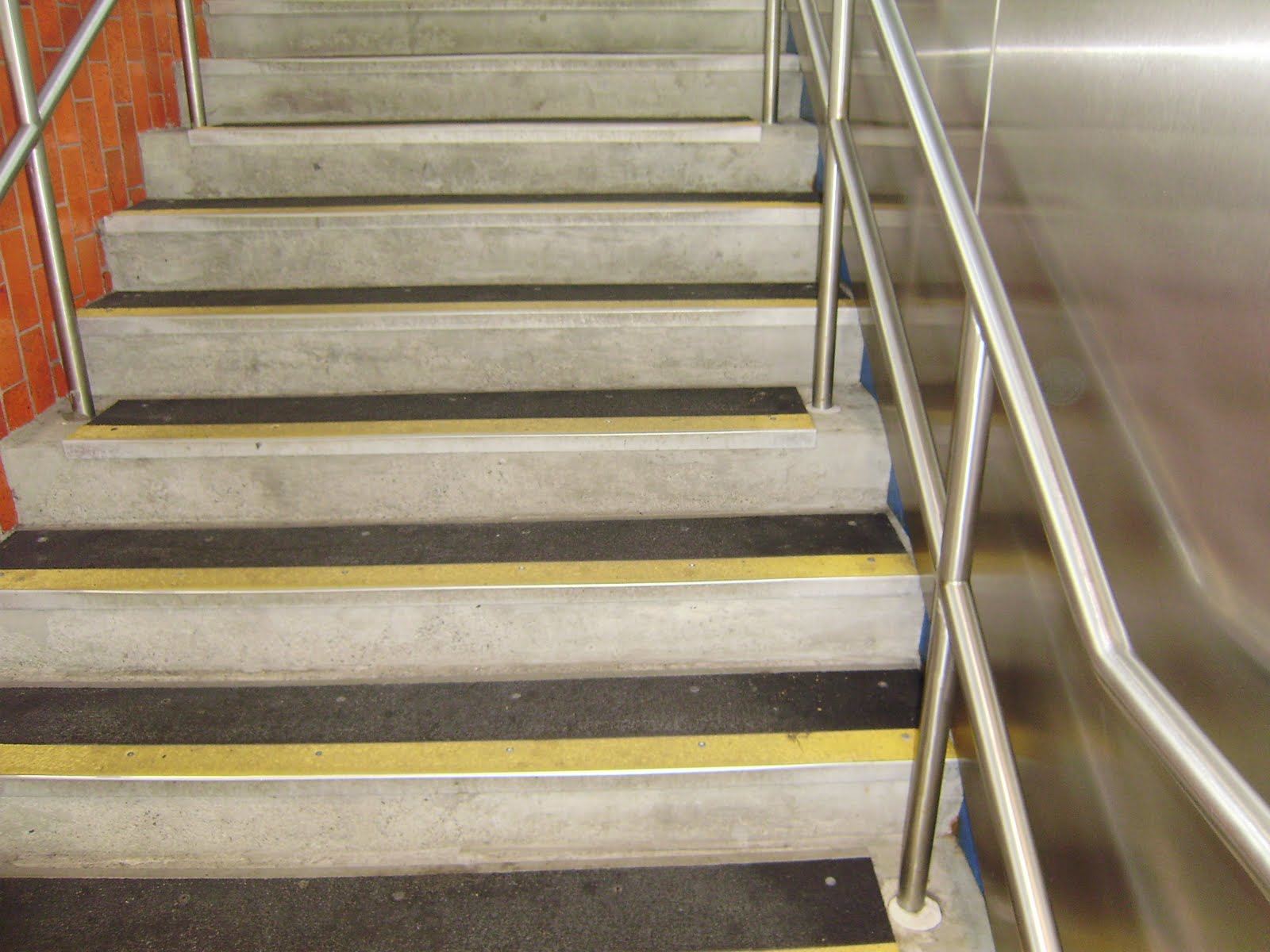
Stairs were poured concrete, but with rubber pads making the climb much easier on the feet. Escalators were provided only for the up direction.


Ottawa plans a sterile zone along its LRT tracks. Draw a line 45 degrees up from the rail, remove all vegetation, so nothing can fall on the track. Boston showed a more tolerant attitude. At this station, there were lots of trees -- probably self seeded -- very close to the train and the rail. Pleasant.

Wednesday, April 7, 2010

Bronson -- stick to the status quo ...


The first meeting of the business advisory committee and the public advisory committee (BAC,PAC) meet with City officials and their consultants last night for the first time about the reconstruction of Bronson Avenue, which will take place in segments over the next few years and chew up $40million dollars.

There was no issue with the need to replace the sewers and watermains, most of which date to the 1887-1907 period. The construction project itself will be major, with trenches up to 24' deep and years of digging, dust, mud...

The main focus was on what is put back on the surface. The City officials and consultants stuck firmly to their position that this is a road project only. Constantly citing the road geometry standards issued by the Roads and Transportation Advisory Council (TAC) and desired lane widths cited in RMOC documents, they want to widen Bronson by an average of 2' throughout its length.

In its present form, Bronson has evolved over many years and each block is slightly different width and angle. The traffic engineers want to smooth out these differences, and make the lanes more standard. The road allowance is narrow however, and to fit in the standardized lanes they intend to "pare back" the sidewalk widths in a number of blocks to the "minimum" widths permitted by the City.


They constantly appealed to the thirty or so community members in attendance to understand that this widening was primarily to benefit cyclists, by giving them more room. The appeal fell flat; most attendees clearly saw it as a subtrefuge for facilitating car traffic.

The consultants cheerfully described how, after all the road widening and utilty work was done, and everything was paved to the limit of the right of way, their landscape architect (mercifully left unnamed) would be let loose to find leftover bits of land to "green" with trees.

It would be safe to say the City official's view of how the scheme would unfold -- you know, stick to the status quo -- was received with as much welcome as a late spring snowfall.

Why, asked the audience, do the planners constantly cite the RTAC lane standards but never the Mainstreet design guidelines? or the "scenic route" designation that Bronson has? (bet you didn't know the city calls Bronson scenic). Answer: "Oh, we will... after we design the traffic lanes, we'll see what space we have left over..."

Why, asked the audience, are all the utilties going to be allowed to bury their wires and ducts as shallow as they want which will prevent later tree planting ... wouldn't it make sense to make the ducts 4' deep so stuff can be planted above? (City answer: "no".)

Why, asked the audience, do the planners constantly work from the position that the road must have at least four lanes? Why not look at making it three lanes with the centre lane reversing at each rush hour, like on the Champlain bridge? Or why not make it two lanes plus parking bays, like has been done on other arterials such as Preston, West Wellington, Somerset? Why not start with the goal of having wide sidewalks, tree lined streets, a liveable street, and then see how many lanes can be fit into that model??  The city answer: "uh, gosh, I guess we can look at those models and then screen them out after looking at them." Yup, that's  what we heard. Actual quote.  No kidding.

It was around this point that Councillor Holmes asked why we couldn't get the same engineers and city planners who worked on Preston and Somerset who understood downtown neighborhoods, livable streets,and listened to residents and local businesses instead of catering to single occupancy car commuters heading to Pointe Gatineau or Barrhaven? Answer: the contract has been let and the city has confidence in its consultants etc etc.

While the city official and planners insisted that they knew the street was designated a traditional mainstreet ... when asked they didn't know what this meant, or what parts of the street held this designation (hint: its Laurier to Carling in the offical plan), or what a scenic route might comprise.

Audience members knew the area well, offering specific comments and complaints. One person (ok, it was me...) recalled when his parents & grandparents lived at the corner of Bronson and Christie and the front yard held a giant tree and green grass and Bronson was only two lanes and families lived all along the road and walked to school ... (warning: don't try these things today). Contrast that to the meeting last night held in the old Immac High School with the din of traffic outside so loud it drowned out the speakers.

They did throw out some bones to the audience. A pedestrian refuge (little triangular island) is proposed for the middle of Bronson on the south side of Albert "because there is too much pavement there we don't need". They will actually decrease curb radii at a number of intersections where one way streets meet Bronson -- mind you, these radii decreases are just going to match the RTAC standards and will decrease the crosswalk distance on already quiet side streets.

They promised to look at the issue of pedestrians crossing Bronson at Arlington (in front of Harvey's ... it is great lunch time entertainment to watch people get stuck on the yellow centre line as they try to cross this street).  They promised, decidedly unenthusiastically I thought, to examine community-suggested improvements to the intersections at Somerset and Gladstone. And pedestrian discomfort at various specific spots, but only to the degree they could do something without increasing the city right of way, ie no property acquisition, and apparently in this 40 million dollar project there is absolutely no budget room for any retaining walls or similar mods that might be necessary to widen a sidewalk against a slope or drop off of as little as 3'.

A hit tune from a few years ago kept going through my head throughout this evening of unfortunate events: stick to the status quo, do what you know. (Maybe it was the high school location that did it...) It will be ... interesting ... to see if this road-widening traffic-facilitating scheme can be turned around into something else. City rights of way like Bronson only get redeveloped once every hundred years, we've got to get it right.

Overly wide city sidewalk awaiting "paring down"